In 2024, more than 95% of Singapore’s small and medium-sized enterprises (SMEs) have adopted at least one form of digital technology, according to the Singapore Digital Economy Report. From accounting software to e-commerce platforms, digital tools are now a standard part of running a business.
For many businesses, this shift didn’t happen all at once. It happened gradually, one tool at a time, chosen to solve a specific problem. A system for accounting. Another for customer orders. Something else for inventory. Each one made sense on its own.
But over time, things start to shift. These tools begin to sit side by side rather than work together. And instead of simplifying operations, they quietly introduce new layers of manual work in between.
You might recognise this in your own operations.
Orders come in through WhatsApp. Your team copies them into Excel. Then someone else re-enters the same data into accounting software to generate invoices, while inventory is updated separately.
It’s a system that works, until it doesn’t. Small inefficiencies start to add up. A mistyped number here, a missed order there, duplicated entries when things get busy. And slowly, more of your team’s time gets spent not on running the business, but on maintaining the flow of information between systems. This is often the point where many SMEs start looking for a better way to connect everything together. Like custom software.
Whether you’re a Singapore business owner considering your first custom-built system or you’re an operations manager simply exploring your options, this article will walk you through everything you need to know.
Key Takeaways:
- Custom software is a tailor-made application built from the ground up to match your business’s unique workflows, rather than forcing you to adapt to a generic, one-size-fits-all product.
- While off-the-shelf tools are cheaper and faster to deploy, custom software eliminates inefficiencies like manual data entry and disconnected systems, turning workarounds into automated processes.
- For most Singapore SMEs, a custom project falls into the mid-size range (SGD 50,000-150,000), but government grants like CTC and EDG can support much of the qualifying costs.
- The right development partner is more than just a technical builder. They should be a business problem solver with a proven track record, strong capabilities, and ideally, recognition from government agencies or industry bodies.
- In 2026, practical AI and cloud-based systems are no longer optional frills but essential features that determine whether your software stays relevant.
What Is Custom Software?

Custom software, also called bespoke or tailor-made software, is an application designed and built specifically for your organisation. It is not a ready-made product you buy off a shelf and install. It is a tool crafted from the ground up to match the unique way your business operates, solves problems, and interacts with customers.
To make this clearer, let’s go back to the earlier example. Imagine your business receives customer orders through WhatsApp. Today, your team might:
- Copy order details into Excel
- Check stock manually
- Re-enter the same data into an invoicing system
- Update inventory separately
This process works, but it is repetitive, time-consuming, and prone to errors.
A custom software solution would streamline this entire flow.
Instead of jumping between tools, you and your team could save human time to do higher value tasks such as relationship building and sales follow up, with orders, invoices, and inventory all updated and generated automatically.
What used to take multiple steps across different tools becomes something your team can complete in just a few clicks. No copying. No duplication. Fewer mistakes. To understand this fully, it helps to contrast it with the software you likely use every day. An off-the-shelf software.
What Is an Off-the-Shelf Software?

An off-the-shelf software refers to ready-made applications sold to a mass market. Think Microsoft Office, Xero, or Shopify.
These tools have a “one-size-fits-all” philosophy. They are designed to appeal to the widest possible audience, which means they often include hundreds of features you will never touch.
Research shows that approximately 85% to 90% of features in off-the-shelf products go completely unused by customers.
This means you are essentially paying full subscription fees for functionality that delivers little to no operational value.
Think about the last software subscription your business paid for. How many of its features does your team actually use? And how much time is your team spending on repetitive data entry across multiple of these softwares? These are often early signs that your current tools are no longer keeping up with your business.
Based on our experience, usually Singapore SMEs with at least 8 or more employees start to feel the need for custom software.
Common Types of Custom Software For Singapore SMEs
While the earlier example focuses on order processing, custom software can apply across many parts of your business, wherever there is manual work, duplicated effort, or disconnected systems.
In practice, most SME use cases fall into a few key areas:
1. Operations and Workflow Automation

This is the most common starting point for SMEs.
It focuses on removing repetitive manual work and connecting disconnected processes.
For example:
- Orders coming in from different channels are automatically captured
- Invoices are generated without manual data entry
- Inventory updates in real time
Instead of your team moving information between systems, this type of system handles it automatically. At a larger scale, this is how ERP systems work.
This is where businesses typically see the fastest return, because it directly saves time and reduces errors.
2. Sales and Customer Management

Many SMEs manage customers across multiple platforms, WhatsApp, email, spreadsheets, with no single source of truth.
Custom software can bring everything together into one system.
For example:
- All customer enquiries are captured in one place
- Sales pipelines are tracked clearly
- Follow-ups are automated or prompted by AI agents
- This gives your team visibility and structure, instead of relying on memory or scattered notes.
3. Reporting and Business Insights

A common challenge for SMEs is not lack of data, but lack of clarity. Data exists across multiple tools, but it is difficult to piece together.
Custom software can consolidate this into simple, real-time dashboards.
For example:
- Sales performance across channels
- Order volumes and trends
- Cash flow visibility
Instead of manually compiling reports, your system shows you what’s happening in real time.
4. Customer-Facing Systems

Custom software is not only for internal use, it can also improve how customers interact with your business.
For example:
- Booking systems
- Ecommerce website with online payment
- B2B ordering portal with credit control
This type of system reduces manual back-and-forth while improving the customer experience.
5. Internal Tools and Team Management
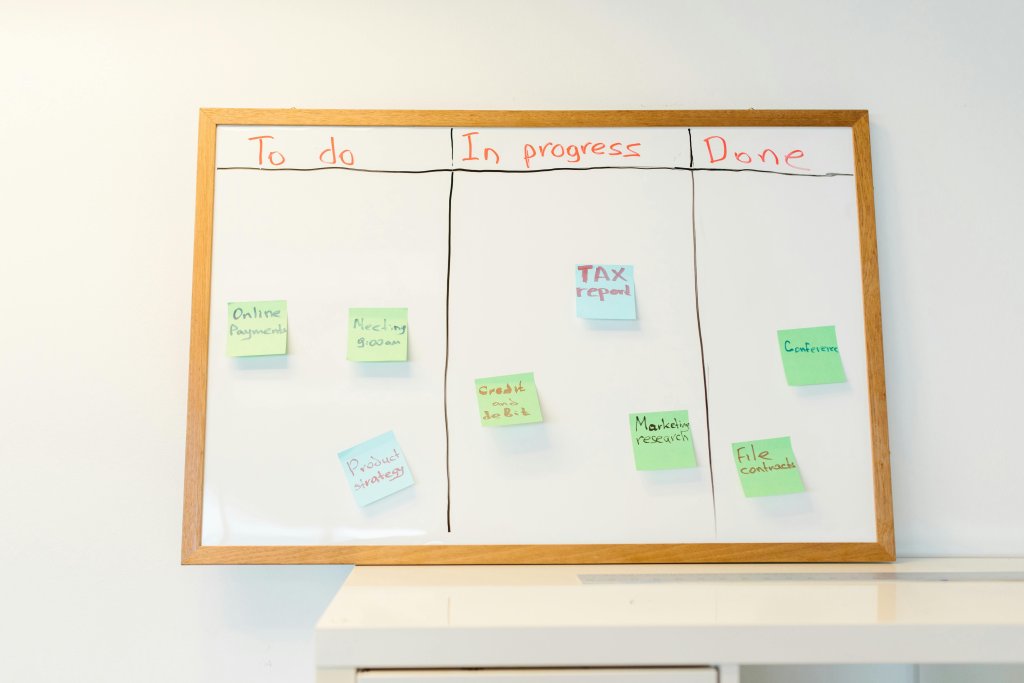
Some of the biggest inefficiencies happen internally.
Custom tools can simplify coordination and reduce administrative overhead.
For example:
- Staff scheduling systems
- Project & task management
- Consolidated sales order system
These systems ensure everyone is aligned without constant manual coordination.
Of course, these are just a few common starting points. Custom software can be built around literally anything. If a process exists in your business, a good custom software developer can map, improve, and build it into a system that works the way you want.
Custom Software vs. Off-the-Shelf: A Comparison
Now that you have a clearer idea of what custom software can do, the next question becomes: “How does it compare to the tools you’re already using today?” Understanding the trade-offs between custom and off-the-shelf software is essential for making an informed decision. Here’s a quick comparison between off-the-shelf software and custom software:
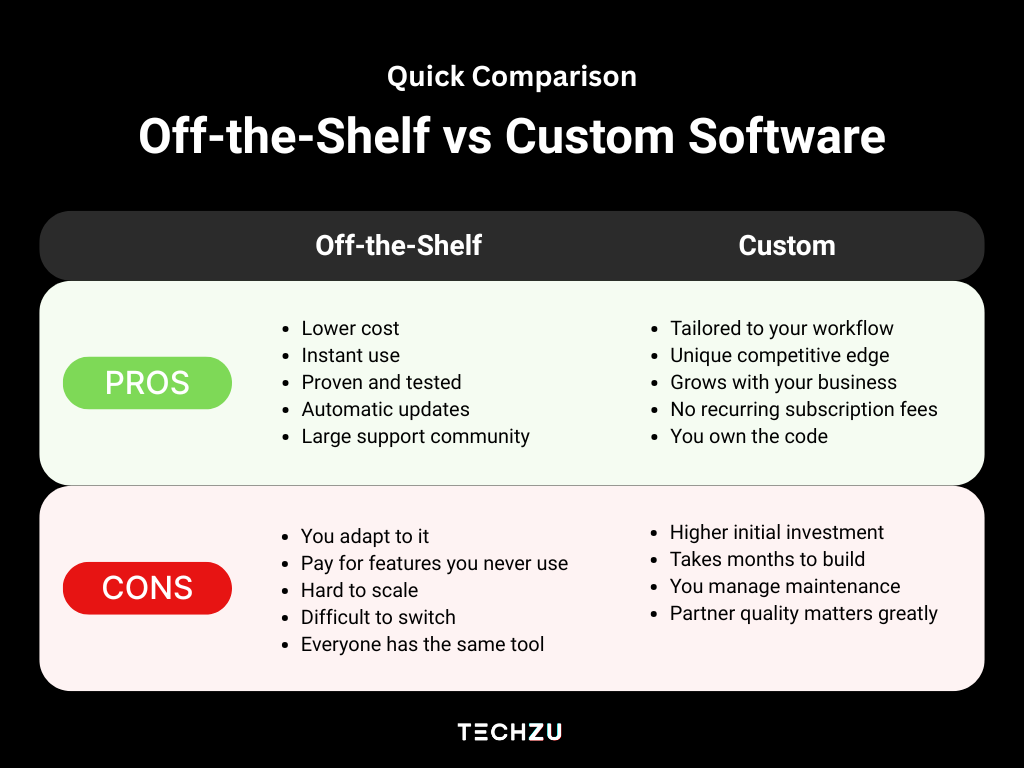
Let’s take a closer look at what this actually means.
Off-the-Shelf Software
This is what most SMEs start with, and for good reason.
Advantages:
- Lower cost: You pay a subscription fee, either monthly or annually.
- Quick deployment: You can sign up and start using the software almost immediately.
- Proven and reliable: These tools are widely used and tested across many businesses.
- Ongoing support and updates: Security patches, updates, and improvements are handled for you.
- Strong ecosystem: Tutorials, guides, and communities make it easy to learn and troubleshoot.
Disadvantages:
- You adapt to the software, not the other way around: Your team has to follow the tool’s structure, even if it doesn’t match how you actually work, like forcing your sales process into fixed stages that don’t reflect how your team actually closes deals.
- Paying for what you don’t use: Many features go untouched, yet you still pay full subscription fees.
- Workarounds increase over time: As your business grows, you start adding spreadsheets and more off-the-shelf software to “make things work.”
- Difficult to switch later: Moving to another system can be costly and disruptive.
- No built-in competitive advantage: Your competitors can use the same tools, so you’re not faster, more efficient, or easier to work with than them
Each step works, but the overall process might not be as efficient as you like.
Custom Software
Custom software is designed around your business, not the average user.
Advantages:
- Built for your exact workflow: Instead of forcing your team into rigid steps, the system follows how you already operate.
- Real efficiency gains: What used to take multiple tools and steps can often be reduced to a few clicks.
- Creates a competitive edge: You’re not just using software, you’re building a way of operating that others can’t easily copy.
- Scales with your business: As your operations grow, the system evolves with you instead of breaking or needing replacement.
- Long-term cost efficiency: Higher upfront cost, but no ongoing subscription bloat and fewer manual labour costs.
- Greater control and ownership: You own the system, the data, and how it evolves.
Disadvantages:
- Higher upfront investment: You pay to build it from scratch.
- Takes time to develop: Unlike off-the-shelf tools, you don’t get instant deployment.
- Ongoing responsibility: Maintenance, updates, and improvements need to be managed.
- Depends on the right partner: A strong software development company makes all the difference.
The choice ultimately comes down to fit.
If your operations are simple and align well with existing tools, off-the-shelf software will take you far. But if your business is growing, relies on workarounds, duplicated data, and disconnected systems, those inefficiencies will only compound over time.
So what does it actually take to build one?
The Custom Software Development Process
If this is your first time exploring custom software, the process can feel complex and overwhelming. In reality, it follows a structured approach. What matters most for you in the software development process is understanding where your input is needed.
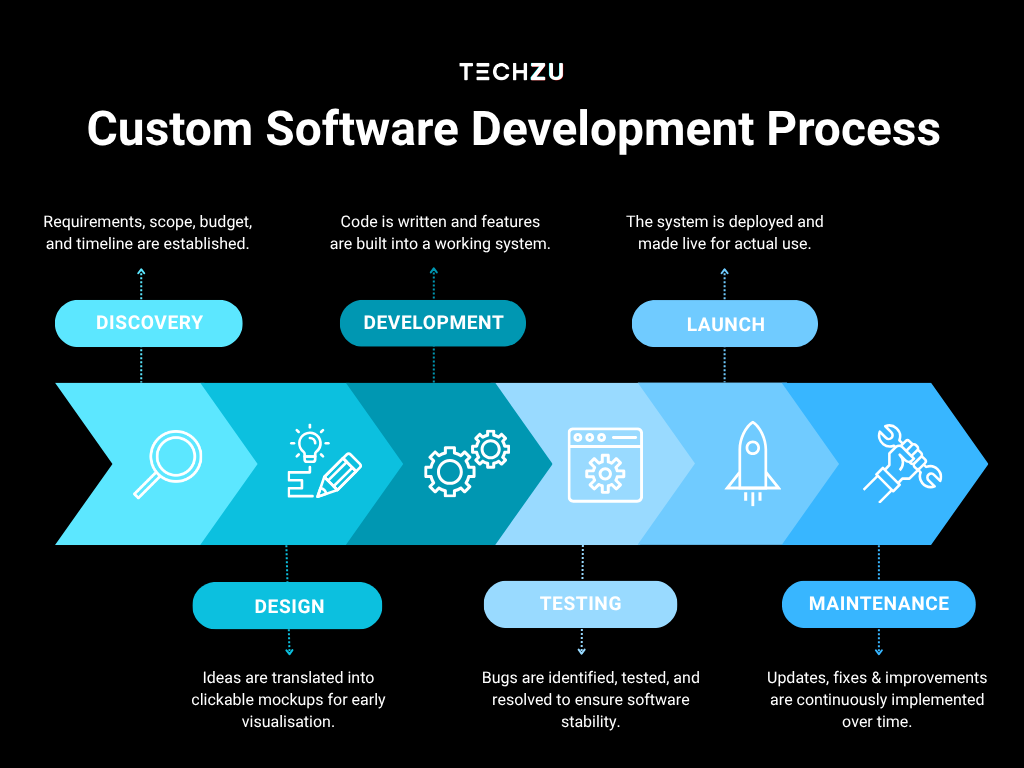
Step 1: Process Discovery
You and your custom software development company sit down and map out exactly what the software needs to do. No coding yet. Just whiteboards, coffee, and honest conversations.
You leave with a clear scope, budget estimate, and timeline.
Step 2: System Design
The developer creates clickable mockups. You can click through a pretend version of your software before anyone writes a single line of code.
You leave with a design you can test with your team.
Step 3: Development
The actual building happens. Good developers show you working versions every 12 weeks.
You leave with a working but not-yet-polished system.
Step 4: User Acceptance Testing
Your team tests the software with real data. You find bugs. The software development team fixes them. You test again.
You leave with a stable, tested system.
Step 5: Deployment
You move from your old systems to the new one. The developer stays on standby for the first few days.
You leave with live software.
Step 6: Training
Your team is guided on how to use the system in real day-to-day scenarios. This usually includes hands-on walkthroughs, role-based training sessions, and simple user guides. The goal is not just to “teach the software,” but to ensure your team is comfortable using it as part of their normal workflow.
You leave with a team that is confident and ready to operate the system independently.
Step 7: Enhancement & Continuous Training
Once the system is live, improvements don’t stop.
Bugs are fixed, small enhancements are rolled out, and the system is refined based on real user feedback and actual business usage. Over time, the software evolves alongside your business, adding new features, improving performance, and adapting to changing needs.
You leave with a system that continues to stay relevant and useful, not something that becomes outdated after launch.
Most custom software projects take anywhere from a few months to over a year, depending on complexity.
While that may sound like a long time, each stage is designed to reduce risk and ensure the final system actually works for your business. Not just in theory, but in practice.
Understanding Custom Software Development Costs
By this point, you should have a clearer sense of whether custom software makes sense for your business. But what is it going to cost you? Let’s take a look.
Based on 2025 market data, here are typical cost ranges for custom software in Singapore:
- Small systems (basic tools): SGD 20,000 – 40,000
Simple internal tools with basic data entry and reporting
- Mid-size systems (most SMEs): SGD 50,000 – 150,000
Systems with multiple workflows, roles, and automation
- Large systems (end-to-end operations): SGD 200,000 – 350,000
More complex platforms with deeper business logic
Most SMEs typically falls into the mid-size range, depending on how advanced it needs to be.
What Factors Affect Software Development Costs?
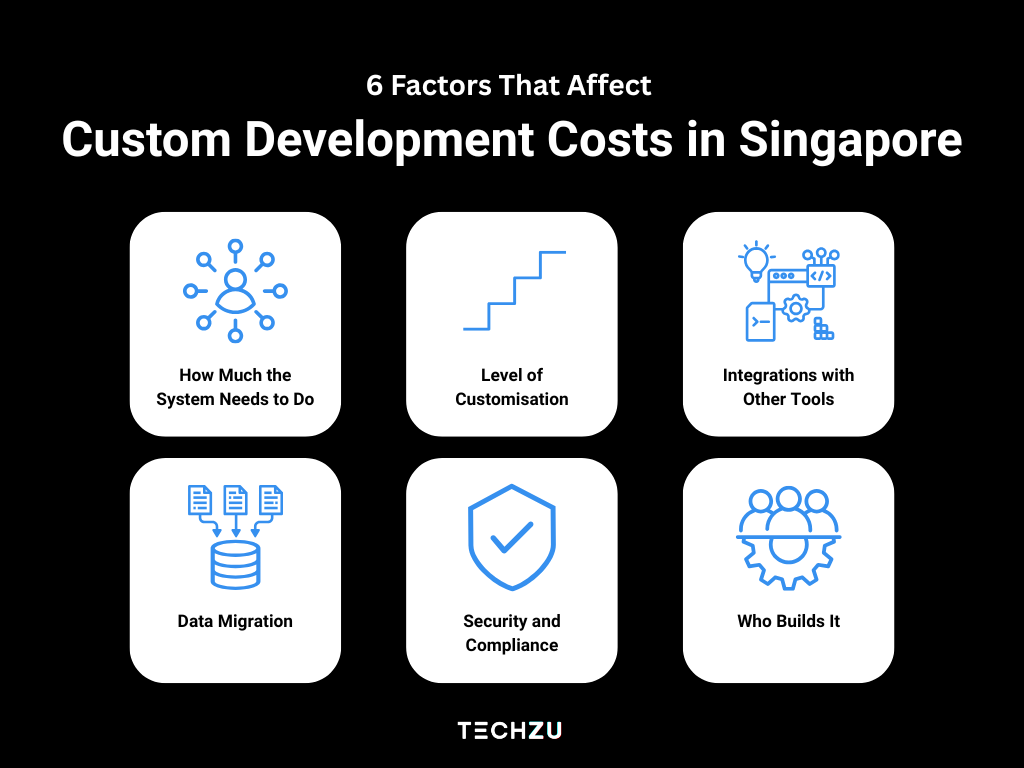
1. How Much the System Needs to Do
The biggest factor is complexity. A simple tool that just captures orders is relatively affordable.
But if your system also:
- Tracks inventory
- Generates reports
- Integrates with accounting software
Then the cost increases, because more logic and connections are involved.
2. Level of Customisation
A usable interface is the baseline. What increases cost is going beyond that, when the system is tailored very specifically to your operations.
For example:
- Custom workflows unique to your business
- Role-based dashboards for different team members
- Highly optimised user flows to reduce steps and errors
The more the system is shaped around how your team actually works, the more design and planning is required.
3. Integrations with Other Tools or 3rd-Party Portal
This is a big one.
The complexity of your system increases significantly based on how many tools and platforms it needs to connect with, whether its internal systems or external 3rd-party portals such as government portals, accounting software (e.g. Xero), and other service providers.
For example:
- Manual order entry → simpler
- Auto-pulling data from WhatsApp → more complex
The more systems you connect, the more work is required.
4. Data Migration
If you already have:
- Excel files
- Old systems
- Customer records
Moving that data into the new system takes time, especially if the data is messy or inconsistent.
5. Security and Compliance
If your system handles:
- Customer data
- Payments
You’ll need proper safeguards in place, especially for PDPA compliance in Singapore. This includes access controls, data protection measures, and secure storage.
6. Who Builds It
Who you work with affects both cost and experience.
- Local Singapore teams → higher cost, easier communication, better alignment
- Offshore teams → lower cost, but may require more coordination and oversight
Hidden Custom Development Costs You Might Not Expect
Development is only part of the investment. To run your system properly, you should also budget for:
- Hosting: This is the cost of running your software on servers so your team can access it anytime.
- Maintenance (15-20% per year): Ongoing updates, bug fixes, and small improvements to keep the system stable and secure.
- Testing and QA: Ensures the system works correctly under real-world conditions and prevents costly issues after launch.
- Compliance (if needed): Additional work to meet legal or industry requirements, such as data protection standards.
At the end of the day, cost comes down to scope. The more you want the system to do, the more it will cost, but also the more it can help your operations.
Technology Trends Shaping Custom Software in 2026
So far, we’ve focused on how custom software works today. But what you build now needs to stay relevant tomorrow. Technology is evolving quickly, and these are the trends shaping how custom software is designed in 2026.
1. AI Is No Longer “Fancy”, It’s Practical

A few years ago, AI meant expensive robots or sci‑fi movies. Now? It’s more like a super‑helpful assistant that works inside your software. And it’s now helping SMEs around the world. Here’s what it’ll look like for Singapore SMEs:
- Automatically sort orders. The system reads “10 boxes of durian puffs” and knows it’s a food order, not a delivery note.
- Predict when you’ll run out of stock. “You usually sell 50 packs of curry sauce every Friday. Reorder by Thursday.”
- Generate daily reports instantly. No more asking someone to spend an hour on Excel.
Imagine your order system spots that customer Jun buys the same three items every month. AI can suggest a repeat order or send him a reminder. That’s not magic, it’s just smart software.
2. Cloud‑Based Systems Are Now the Default

“The cloud” just means your software lives on the internet, not on a single computer in your back office. That means:
- Your team can work from anywhere. At the shop, at home, or even from a coffee shop by the Bay.
- No expensive servers to buy or maintain. That’s one less thing to worry about.
- Easy to grow. Add more users or more data without rebuilding everything.
If your warehouse manager checks stock on a tablet in Jurong, your accountant can also check the same numbers on a laptop in Tai Seng. Both see real‑time updates. No “please email me the latest file” ever again.
3. Cybersecurity Is Not Optional Anymore

You might think hackers only target big companies. That’s no longer true. In fact, attackers now go after smaller systems because they’re easier to break into. Here’s what your custom software must have at a minimum:
- Secure login: Not just a password. Ideally two‑factor authentication (like a code sent to your phone).
- Encrypted data: Even if someone steals the data, they can’t read it.
- Access controls: Your cashier doesn’t need to see profit margins. Your manager doesn’t need to change prices accidentally.
Imagine if you’re a small fashion boutique in Singapore that has a custom loyalty system. No encryption. A former employee’s friend accessed the system and downloaded all customer phone numbers. The boutique had to report it under PDPA, which was costly and embarrassing.
Security is no longer an “add‑on” you think about later. It must be built into your software from day one.
These trends define what good software looks like in 2026. The better your system aligns with them, the more value it will deliver over time.
How to Choose the Right Custom Software Development Partner
Even the best idea can fail with the wrong partner. In fact, in most failed projects, the problem is not the software itself, it’s how it was planned, communicated, or executed. That’s why choosing the right development partner is just as important as the idea itself.
Here’s a practical step-by-step way to get it right.
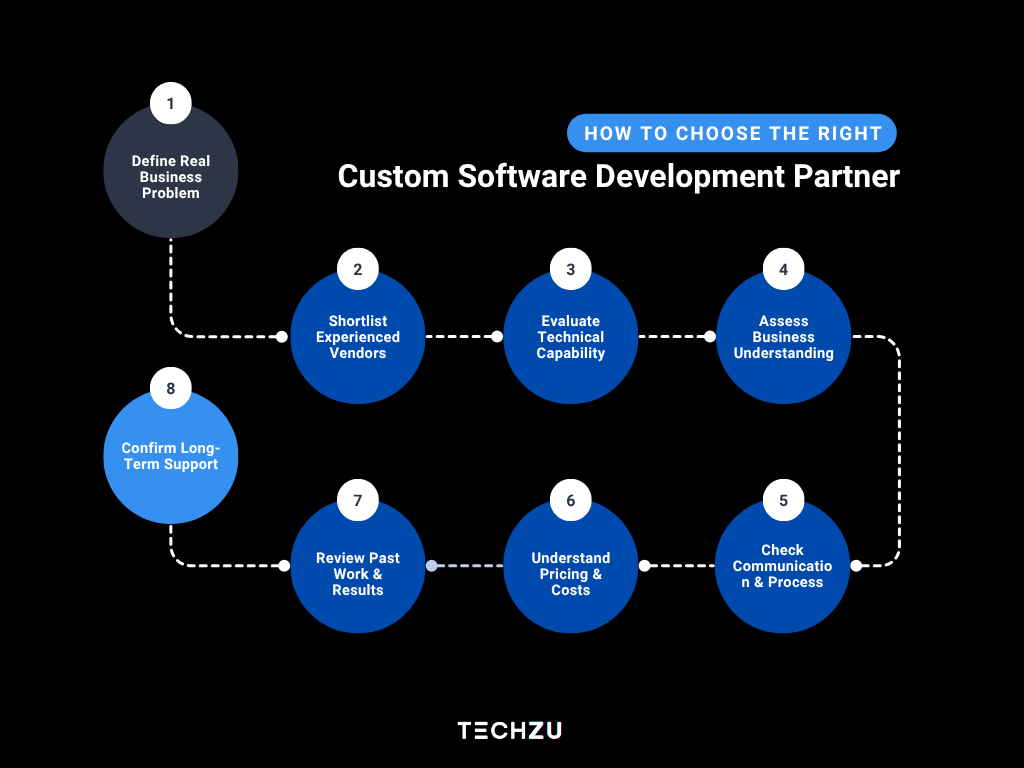
Step 1: Define Your Business Problem Clearly (Not Just the Solution)
Before looking for developers, get very specific about:
- What problem are you trying to solve?
- Who is affected internally (sales, ops, finance, customers)?
- What does success look like (time saved, revenue increase, fewer errors)?
Here are a few examples:
- Instead of “we need an app,” define it as: “We need to reduce manual order processing time from 3 days to 1 hour”.
- Clear problems attract a better software development company in Singapore and reduce miscommunication later.
Step 2: Shortlist Vendors with Relevant Industry Experience
Not all developers are equal. Look for a software development team who:
- Have worked with SMEs (not just large enterprises)
- Understand your industry (retail, logistics, F&B, etc.)
- Have case studies or demos you can verify
In Singapore, experience with local workflows like GST, invoicing norms, PDPA compliance is a strong plus.
Step 3: Evaluate Technical Capability (Without Getting Too Technical)
You don’t need to understand coding, but you should check:
- Do they build scalable systems (can grow with your business)?
- Do they use modern, maintainable technologies?
- Can they integrate with your existing systems (accounting, ERP, CRM)?
Ask them to explain their past projects in simple terms.
Step 4: Assess Their Understanding of Business, Not Just Tech
A strong partner should ask:
- Why is this process done this way?
- What is the business impact of delays or errors?
- How will staff actually use the system daily?
If they only talk about features and not outcomes, they may not be the right fit.
Step 5: Check Communication Style and Project Management Approach
For SMEs, communication often matters more than raw technical skill. Look for:
- Clear project timelines and milestones
- Regular updates (weekly or bi-weekly)
- A dedicated project manager or point of contact
Ask:
- “How will I track progress?”
- “What happens if requirements change mid-project?”
Step 6: Understand Pricing Structure and Hidden Costs
Most custom software projects are priced in one of three ways:
- Fixed price: A set cost agreed upfront. Good for clear, well-defined projects.
- Time & materials: You pay based on actual work done. More flexible, but can vary in cost.
- Dedicated team: A long-term setup where you effectively “rent” a development team.
Also clarify:
- Maintenance and bug fixes
- Hosting and infrastructure
- Future updates or feature improvements
Many SMEs focus only on the initial build cost and underestimate what it takes to keep the system running smoothly over time.
Step 7: Review Portfolio, References, and Real Results
Don’t just look at screenshots, ask for:
- Live systems (if possible)
- Client references
- Measurable outcomes (e.g., “reduced processing time by 40%”)
If they’re able to share references, it’s a strong sign of transparency and proven experience.
Step 8: Test with a Small Pilot or Prototype
Before committing to a full build:
- Start with a prototype or MVP (Minimum Viable Product)
- Validate usability with your internal team
- Check if assumptions about workflows are correct
This reduces risk of expensive rework later.
Step 9: Confirm Post-Launch Support and Long-Term Partnership
Software is not a one-time project. Ask:
- Do they provide maintenance and bug fixes?
- How fast is their support response time?
- Can they scale the system as your business grows?
The best partners act like long-term collaborators, not one-off vendors.
For Singapore SMEs, the right custom software partner is not just a technical builder, it’s a business problem solver who can translate operations into scalable systems. If you choose and engage with the right SME software development services carefully at the start, you save significant cost, time, and frustration later.
Singapore-Specific Considerations for Custom Software Development

Let’s move from theory to reality in Singapore.
Building custom software here isn’t just about technology, it also involves government support, regulatory requirements, and practical business advantages that can significantly shape your decision.
Government Grants and Support for Custom Software
One of Singapore’s biggest advantages for SMEs is the availability of funding support for digital transformation.
Productivity Solutions Grant (PSG)
- Covers up to 50% of the cost of IT solutions and equipment
- Includes pre-approved digital solutions, including some custom software components
- Maximum support: up to SGD 30,000 per SME
Enterprise Development Grant (EDG)
- Supports broader business transformation and growth projects
- Covers up to 50% of qualifying costs for SMEs (30% for larger firms)
- Includes consultancy, software development, and process improvement
SkillsFuture Enterprise Credit (SFEC)
- A top-up credit that helps eligible companies offset out-of-pocket costs after applying for PSG or EDG
- Provides additional SGD 10,000 credit
CTO-as-a-Service (IMDA)
- A 24/7 one-stop platform to help SMEs explore digital solutions
- Browse and compare over 300 pre-approved, market-proven SME software solutions with grant support
- Access Industry Digital Plans covering 22 industry sectors for step-by-step guidance
SMEs Go Digital Programme
- Over 95% of Singapore SMEs have adopted at least one digital area under this programme
- Over 400,000 users accessed CTO-as-a-Service in 2024
- Around 30% of pre-approved solutions now include AI capabilities
Before starting a custom software project, check whether parts of it (e.g., integration middleware, standard modules) can leverage pre‑approved PSG solutions, while the unique logic falls under EDG. Many Singapore software development firms help with grant applications. Apply through the Business Grants Portal at www.businessgrants.gov.sg.
Custom software may seem expensive upfront. But with grants, the actual cost can be significantly reduced.
Compliance and Data Protection (PDPA)
Beyond funding, Singapore also has strict expectations around how businesses handle data. Any custom software that stores or processes customer information must comply with the Personal Data Protection Act (PDPA). In practical terms, this means:
- Security by design: data protection must be built into the system from the start
- Consent management: clear tracking of user consent for data collection
- Breach readiness: systems should support detection and reporting of data breaches
- Access control: only authorised staff should access sensitive data
- Data visibility: clear understanding of where customer data is stored and used
SMEs can use the Data Protection Essentials framework and checklist provided by the Personal Data Protection Commission (PDPC) to implement baseline data compliance practices.
Cybersecurity Expectations for SME Software
As more business operations move online, cybersecurity is no longer optional. The Cyber Security Agency of Singapore (CSA) provides the Cyber Essentials Mark, which outlines baseline protections for SMEs.
For custom software, this typically includes:
- Secure authentication (strong password policies, multi-factor authentication)
- Data encryption both in transit and at rest
- Regular security updates and patching
- Access logs and monitoring for suspicious activity
- Secure API design for system integrations
These measures help reduce the risk of common cyber threats that increasingly target smaller businesses.
Why Custom Software Works Well in Singapore

Beyond policy and compliance, Singapore’s business environment itself makes custom software especially relevant. Several factors stand out:
- Rising labour costs: Custom software can automate manual processes, reducing reliance on expensive labour and improving productivity.
- High digital maturity: With 95.1% of SMEs already digitally engaged, the foundation is in place for more sophisticated, tailored solutions.
- Strong competition: Singapore is a small but intensely competitive market. Custom software can provide the differentiation needed to stand out.
- Government support: The availability of PSG and EDG grants substantially reduces the effective cost of custom development for qualifying projects.
- Regional expansion: 82% of Singapore SMEs plan to expand overseas in 2026, according to a DBS survey.
Custom software built for scalability can support multi-country operations more effectively than off-the-shelf alternatives.
Between strong government support and clear regulatory standards, Singapore gives SMEs a rare advantage in digital transformation. The differentiator is no longer access to technology, but how effectively it is applied.
Why Custom Software Projects Fail (and How to Get It Right)
Before we wrap up, let’s address a question that’s likely on your mind: If custom software is so powerful, why do some projects fail?
For SMEs, failure rarely happens because of bad code. It happens because of mismatched expectations, unclear processes, or trying to do too much at once. A custom software project can fail when:
- Business workflows aren’t properly documented before development begins.
- The SME is forced to adopt an entire system overnight, leading to downtime and team resistance.
- Unexpected recurring costs like hosting, maintenance, and third-party APIs blow the budget months after launch.
- The finished system automates the wrong things, delivering little real business value.
At Techzu, we’ve structured our entire approach to prevent these exact scenarios. Here’s how we ensure success for Singapore SMEs:
- We partner with consultants like BDO Singapore to ensure all workflows and business processes are documented and reviewed.
- We help SMEs plan a practical digitisation roadmap, instead of “force-feeding” the entire system to them. We deliver in phases, so your team can adapt quickly, downtime is minimised, and you see value early.
- We are transparent about recurring costs from day one. We provide upfront guidance on recurring costs for having specific features, helping SMEs make cost-effective and sustainable decisions.
- We never lose sight of business value. Every feature we design and develop is measured against one question: Does this directly help your business run better, save money, or serve customers faster?
Because at the end of the day, great software isn’t just code that works. It’s code that works for your business.
Conclusion
Custom software development is not just about technology, it is about building a tool that works exactly the way your business works. For Singapore SMEs navigating a competitive landscape, rising costs, and increasing customer expectations, custom software can be a strategic investment that pays dividends for years to come.
The key to success lies in preparation. Understand your requirements, choose the right development partner, plan for the full lifecycle of costs, and leverage the substantial government support available to Singapore businesses.
Custom software is not the right choice for every situation, but when your business has unique needs that off-the-shelf solutions cannot meet, it can be the difference between being constrained by your tools and being empowered by them.
If you’re looking for an expert team to build custom software for your business, Techzu’s software development services are built for exactly this kind of work and will handle everything from grants to compliance to development.
About Techzu
Techzu is an award-winning digital partner helping Singapore SMEs automate, grow, and compete with cost-effective, ROI-driven solutions in AI, automation, website development, and custom software, backed by 120+ successful projects for 80+ clients across multiple industries.
FAQ
Custom software is a tailor-made system built specifically for your business processes, instead of using a one-size-fits-all app.
Off-the-shelf software is ready-made for general use, while custom software is built around your exact workflows and requirements.
Yes, especially if you rely on manual processes, spreadsheets, or multiple disconnected tools that don’t integrate well.
It reduces manual work, removes duplicate data entry, connects systems, and improves overall operational efficiency.
Most SME projects range between SGD 18,000-22,000, depending on complexity and features.
It has higher upfront cost, but often lower long-term cost due to reduced subscriptions and improved efficiency.
Typically 3 to 12 months, depending on the complexity and number of features required.
Common types include workflow automation systems, CRM tools, inventory systems, reporting dashboards, and internal management tools.
Yes, it can integrate with accounting software, WhatsApp, payment systems, ERPs, and other business tools.
Yes, if properly built with encryption, access controls, and compliance with PDPA and cybersecurity standards.
Yes. Grants like EDG can cover up to 50% of qualifying costs, while CTC can cover up to 70% for eligible SMEs.
The biggest risk is building a system that doesn’t align with how the business actually operates.
At Techzu, we reduce this risk by ensuring workflows are clearly documented upfront, rolling out systems in phased stages for easier adoption, being transparent about long-term costs, and focusing every feature on clear business value.
No. A good development partner should translate your business needs into technical solutions for you.
Yes. It is designed to evolve with your operations, unlike many off-the-shelf tools that become limiting over time.
Look for business understanding, clear communication, relevant SME experience, and strong post-launch support.
We follow a structured, phased approach, from workflow discovery and system design to development, testing, and deployment. At every stage, we work closely with clients to ensure the system reflects real business operations.
We don’t just build software, we focus on business outcomes. Every project is designed around efficiency, cost savings, and scalability, with strong emphasis on planning, phased rollout, and long-term usability.
Start with your processes, not the software. If your workflows are not clearly defined, even the best system will not deliver value. Clarity upfront is the biggest factor in project success.
Yes. We invest heavily in the discovery phase to map out workflows, identify inefficiencies, and define clear requirements before any development begins. This reduces rework and ensures alignment.
We prefer phased implementation. This allows SMEs to adopt the system gradually, reduce disruption, and start seeing value early instead of waiting for a full system to be completed.
We evaluate features against business impact, whether it reduces manual work, improves efficiency, or supports better decision-making. If it doesn’t add value, we don’t build it.
Yes. We provide ongoing support, enhancements, and maintenance to ensure the system continues to perform well as the business grows and evolves.