
Choosing a custom software development company in Singapore involves more than comparing quotations and technical capabilities. You need a development partner that understands how local businesses operate, can integrate with your existing systems, and knows how to build software that meets your operational and regulatory requirements.
This is increasingly relevant as more Singapore businesses invest in digitalisation. According to the Ministry of Digital Development and Information (MDDI), 96.4% of enterprises in Singapore adopted at least one digital solution in 2025, compared with 84.6% in 2019. Meanwhile, IMDA reported that 97% of SMEs had adopted at least one sector-specific digital solution in 2024.
However, finding the right development partner can be challenging. With different companies specialising in mobile apps, business systems, automation and web applications, how do you know which one is suitable for your project? Here are the key factors to consider when choosing a custom software development company:
1. Understand Your Business Requirements First

Before approaching a software development company, identify the problems you want to solve and what you need the software to do. This helps developers recommend a suitable solution and provide a more accurate quotation.
Start by considering:
- Business objectives: Are you trying to reduce manual work, improve inventory management or streamline customer orders?
- Target users: Will the software be used by employees, customers, suppliers or business partners?
- Required features: Do you need customer management, payment processing, reporting or automated notifications?
- Existing systems: Does the software need to connect with your accounting, CRM or inventory platforms?
- Budget and timeline: How much are you prepared to invest, and when do you need the system?
You do not need a complete technical specification. A good development partner should be able to guide you through the requirements-gathering process.
Do You Actually Need Custom Software?
It is also worth considering whether an existing application can already meet your requirements. Off-the-shelf software is generally more suitable for standard business functions such as accounting, payroll and basic project management. It is usually quicker to implement and requires a lower initial investment. Custom software in Singapore is more suitable when your business has unique workflows, needs specialised features or requires multiple systems to work together.
For example, a Singapore retailer operating several outlets may need to connect its inventory, point-of-sale, customer loyalty and online ordering systems. A custom solution can bring these processes together instead of requiring employees to update information across separate platforms.
| Take our quiz and answer 10 quick questions to find out whether your business needs a custom software solution or if an off-the-shelf product would be a better fit. |
2. Check Their Technical Expertise and Relevant Experience

Choose a software development company with experience building the type of solution you need. A company that specialises in corporate websites may not necessarily have the expertise to develop an ERP system, mobile application or complex business platform.
Evaluate a custom software company’s technical expertise by looking at whether it has delivered similar projects in your industry or worked with comparable business requirements. Review its experience in areas such as:
| Your industry | Relevant software experience |
|---|---|
| Retail | Inventory management, POS integration and e-commerce |
| Food and beverage | Digital ordering and outlet management |
| Manufacturing | Production planning and stock tracking |
| Logistics | Fleet management and delivery tracking |
| Education | Learning management and training administration |
| Professional services | Client portals and document management |
The company should also be able to explain its technology choices. Ask about the programming frameworks, databases and cloud infrastructure it uses, and whether these are suitable for your project’s requirements.
For example, Techzu works with technologies such as React.js, Node.js, Laravel, MySQL, MongoDB, Flutter, AWS and Microsoft Azure.
You do not need to understand every technology in detail. What matters is whether the developer can explain why it is suitable and how the software can be maintained or expanded in the future. Also clarify who will actually work on your project. Find out whether development is handled in-house or outsourced, who manages the team and who is responsible for testing and delivery.
3. Review Their Portfolio and Previous Projects

A company’s portfolio gives you a better idea of its technical capabilities and the types of business problems it can solve. Evaluate the portfolio of a custom software development firm by looking beyond screenshots and attractive designs. Find out what each project involved, what challenges the client faced and how the software addressed them.
For example, Techzu developed a Field Service Management System for a Singapore air-conditioning servicing company that previously relied on Google Sheets, WhatsApp and paper records. The system brought together job scheduling, technician availability, inventory, customer history, invoicing and contract renewals. Instead of managing these activities across separate tools, the company could handle them through one centralised platform.
Ask potential developers whether they have handled integrations or workflows relevant to your business. Experience with similar requirements can help reduce misunderstandings during development.
Finally, check Google reviews and client references for a software company by looking at its website, particularly its custom software development service page, where client testimonials or case studies may be featured. Pay attention to feedback about communication, project management, delivery timelines and how well the team understood the client’s requirements.
4. Understand Their Development Process and Communication

A reliable development company should have a clear custom software development process covering requirements gathering, design, development, testing and deployment. Although the exact workflow varies, a typical project involves:
- Discovery: Understanding your business processes and software requirements.
- Planning and design: Preparing the system structure, technical specifications and interface designs.
- Development: Building the software based on the agreed requirements.
- Testing: Checking functionality, integrations, performance and security.
- Deployment: Launching the system, migrating data and providing user training where required.
- Ongoing support: Fixing issues and making improvements after launch.
Ask how often you will receive progress updates, who your main point of contact will be and how feedback or changes will be handled.
Should You Choose a Local or Offshore Developer?
Both Singapore-based and offshore development companies can deliver good software. However, consider the differences before deciding.
| Consideration | Singapore-based company | Offshore company |
|---|---|---|
| Communication | Easier to arrange local meetings | May involve time-zone differences |
| Pricing | May have higher operating costs | May offer different pricing structures |
| Local knowledge | May be more familiar with Singapore business practices | Depends on experience with Singapore clients |
| Support | Easier to arrange local discussions | Depends on support arrangements |
A local company is not automatically better, and an offshore company is not necessarily less capable. Focus on the actual software development team, project management arrangements and quality assurance process.
How to assess the project management approach of a software development company?
Ask how the company tracks project progress, manages deadlines and handles changes to requirements. Find out whether it uses project management tools, provides regular updates and involves you at key stages such as design reviews and user acceptance testing. At Techzu, we believe clear communication and regular progress updates are important throughout the development process, so clients know what to expect and can provide feedback along the way. A good development partner should keep you informed, flag potential delays early and make sure you have a clear understanding of what is being delivered at each stage.
5. Compare Custom Software Development Costs and Quotations

Custom software development costs in Singapore depend on the project’s complexity, number of features, integrations and development resources required. A simple internal dashboard will generally cost less than a large ERP system with multiple modules and interconnected business processes.
To give you an idea, here is a typical pricing model for custom software development services:
| Type of software | Starting estimate |
|---|---|
| Dashboards, staff portals and simple workflow systems | From $15,000 |
| Booking, customer management and scheduling systems | From $20,000 |
| CRM systems and automated workflows | From $30,000 |
| Stock management and operational systems | From $40,000 |
| Custom storefronts, marketplaces and AI applications | From $50,000 |
These are starting estimates, not fixed prices or industry-wide market averages. Actual costs depend on the project’s requirements.
When comparing quotations, check whether they include:
- Requirements gathering and UI/UX design
- Front-end and backend development
- Third-party integrations
- Testing and quality assurance
- Deployment and data migration
- User training and documentation
- Warranty and post-launch support
A lower quotation may exclude important features or services. Compare the actual deliverables rather than looking at the total price alone. You should also clarify the pricing model. Some companies offer fixed-price projects, while others charge based on development hours or provide a dedicated team. Ask how additional features and changes to the original scope will be billed. Remember to account for recurring expenses such as hosting, software licences, maintenance and third-party subscriptions.
| Want an all-in-one website package with hosting and essential tools included? Techzu’s website packages come with lifetime hosting, SEO foundation setup and an AI agent, giving you more value in one complete solution. Learn more about our packages → |
6. Check Their Security, Data Protection and Software Ownership Policies

If your software handles customer information, financial records or confidential business documents, security should be part of the development process from the beginning. Ask the company how it protects your data. Depending on your requirements, this may include:
- Access controls for sensitive information
- Data encryption and secure authentication
- Regular backups and recovery procedures
- Security testing and vulnerability assessments
- Monitoring and software updates
You should also clarify where the software and its data will be hosted, who can access them and whether third-party providers are involved.
Are They Familiar with Singapore’s PDPA?
If your software collects or processes personal data, you should consider Singapore’s Personal Data Protection Act (PDPA). For example, a CRM system may contain customers’ names, contact details and purchase histories. Your custom software development partner should understand how these records will be protected and how access will be controlled. If a custom software developer processes personal data on behalf of your business under a written contract, it may act as a data intermediary under the PDPA, with specific obligations relating to data protection and retention.
You can refer to the PDPA guidelines for more information.
Who Owns the Software After Development?
Before signing an agreement, clarify who owns the finished software, including its source code, design assets and custom-built components. Your business should also understand whether it will receive access to the source code repository, technical documentation and administrative credentials. This gives you greater flexibility if you decide to maintain the software internally or engage another developer in the future.
7. Check Whether Your Project Qualifies for Singapore’s EDGE Grant
If you are an eligible Singapore SME planning a digital transformation project, check whether government funding is available before committing to development. EDGE was launched on 30 September 2026, replacing the previous Enterprise Development Grant (EDG), Market Readiness Assistance (MRA) and Productivity Solutions Grant (PSG) for new applications. Some custom software in Singapore and integrated enterprise system projects may qualify under EDGE’s Large-scale Digital Transformation activity, which provides up to 50% funding support for eligible SMEs.
However, not every software development project qualifies. The activity is intended for broader digital transformation that improves core business operations, such as:
- Integrating different business systems
- Automating connected business workflows
- Implementing cloud-based enterprise platforms
- Using data analytics and AI to improve business decisions
For example, integrating sales, inventory, procurement and reporting systems may better align with the activity than simply purchasing a standalone tool to digitise one task.
Before applying, check that your business meets the eligibility requirements and that the proposed project fits the selected activity. You must submit your application before starting work or making payments or deposits to the vendor. EDGE support is provided on a reimbursement basis, subject to the approved project’s conditions.
Refer to Enterprise Singapore’s EDGE Grant FAQs and its Large-scale Digital Transformation requirements for the latest information. You can also engage a custom software development firm to help you prepare the technical project scope, but grant eligibility and approval are determined by Enterprise Singapore.
8. Check Their Post-Launch Support and Contract Terms

Custom software development in Singapore does not end when the system goes live. Your business may need bug fixes, security updates, troubleshooting or additional features as its requirements change. Before hiring a company, clarify:
- How long is the warranty period?
- What types of defects or issues are covered?
- Are maintenance and security updates included?
- How quickly will the company respond to technical issues?
- Are future enhancements charged separately?
You should also make sure your development agreement clearly outlines the project scope, deliverables, payment milestones, change request procedures and intellectual property ownership.
Avoid companies that provide vague quotations, promise unrealistic delivery timelines or guarantee EDGE approval. A reliable development partner should be transparent about what it can deliver and willing to explain potential limitations.
How Do You Choose the Right Software Development Company?
Once you understand your requirements, shortlist three to five software development companies and compare their proposals using the same criteria.
Here are the best practices for vetting custom software developers:
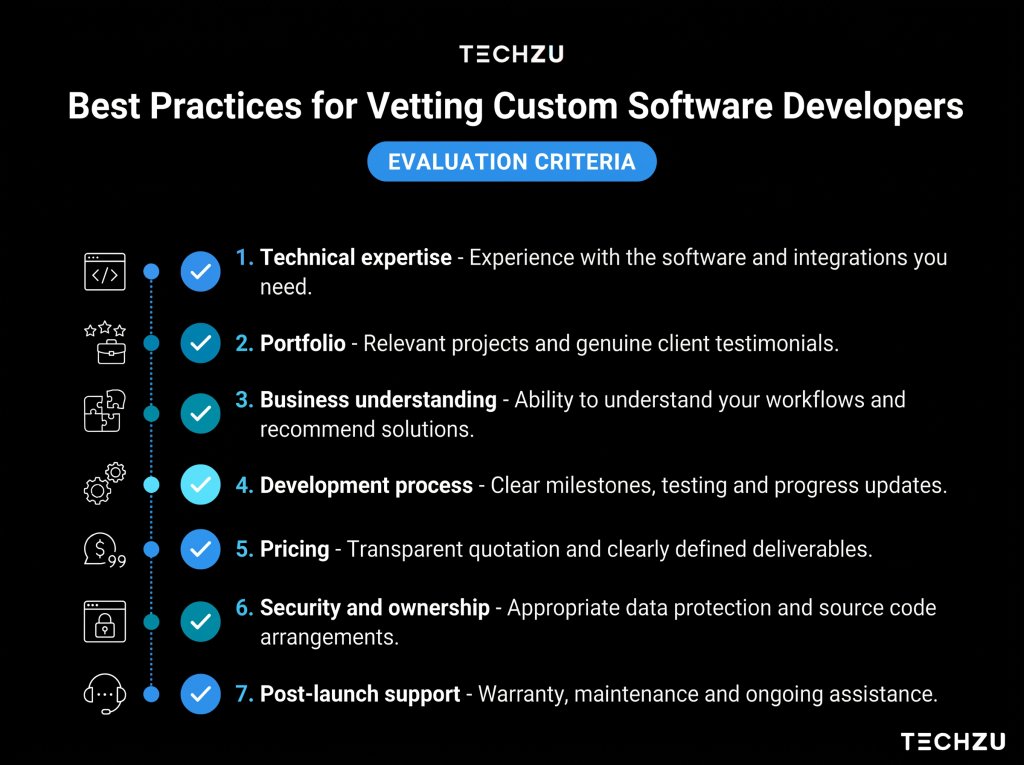
The best choice is not necessarily the cheapest company. Look for a custom software development partner that understands your business, communicates clearly and can support the software beyond its initial launch.
FAQs on How To Choose A Custom Software Development Company
Look for relevant industry experience, a strong project portfolio, technical expertise, clear communication, transparent pricing and reliable post-launch support. Choose a partner that understands your business needs and can build software that scales with your operations.
Ask about their experience with similar projects, development process, project timelines, pricing structure, communication methods, source code ownership and post-launch maintenance. Look at their case studies or client references to assess their track record.
Bespoke software development in Singapore typically costs between $10,000 and $100,000+, depending on the project’s complexity, features, integrations and development time. A simple application may cost $10,000 – $30,000, while more complex CRM, ERP or enterprise systems can exceed $100,000.
Watch out for vague project scopes, unclear payment terms, unrealistic delivery promises, hidden costs and missing clauses on intellectual property ownership, data protection, maintenance and dispute resolution. Make sure all deliverables and responsibilities are clearly documented.
Check Google Reviews, client testimonials on the company’s website, independent business directories. You can also request client references or case studies directly from the company.
Look for relevant credentials such as ISO 9001 for quality management and ISO/IEC 27001 for information security. Depending on your project, knowledge of Singapore’s PDPA requirements and secure software development practices is also important.
Partner with Techzu for Custom Software Development
With over 120 software projects delivered, experience serving 80+ Singapore SMEs and startups, and a 95% client retention rate, Techzu brings proven experience to custom software development. Our in-house team builds tailored CRM and ERP systems, web applications, mobile apps and AI-powered solutions that automate workflows, simplify operations and help businesses scale.
Why choose Techzu for custom software development?
- Built around your workflows: Get software designed around your business processes, rather than having to change how your team works to fit standard solutions.
- Cost-effective solutions: Invest in the features your business actually needs, without paying for unnecessary functions.
- End-to-end development: Work with one in-house team from requirements gathering and design to development, deployment, training and ongoing support.
- Scalable technology: Build a solution that can adapt as your business grows, with the flexibility to add features and integrate other systems.
- Proven project experience: Benefit from Techzu’s experience developing custom solutions for businesses across different industries.
Whether you need to automate business processes, improve team coordination or connect disconnected systems, Techzu can help turn your requirements into practical software.
Speak with Techzu to discuss your project, explore possible solutions and get a free project estimate.