
According to the Singapore Digital Economy Report, almost 30% of Singapore SMEs had an increase in their revenue since adopting AI. Over 85% say it’s saving them time. AI adoption among SMEs tripled in a single year, and yet, only about 1 in 7 SMEs are actually using it. If you’re in that majority, you’re missing out.
In this guide, you’ll learn what AI agents are, how real local businesses are saving operational costs, and how to implement your first AI agent.
Outline:
- What Exactly Are AI Agents?
- How Do AI Agents Work?
- A Quick Note on Terminology
- The Numbers: How Singapore SMEs Are Using AI
- AI Agent Benefits: From Hours Saved to Higher Revenue
- Real-Life Examples: How Singapore SMEs Are Putting AI Agents to Work
- How to Start Using AI Agents: A Step‑by‑Step Roadmap
- AI Agents Risks & Security: What Every SME Owner Must Know
- FAQ
What Are AI Agents?

At its simplest, an AI agent is an application that can observe what’s happening in your business, make decisions, and take action by itself, with minimal human hand-holding.
While all AI agents can act on data and inputs, their level of independence can vary.
Autonomous AI agents are a more advanced type of AI agent that can independently plan, adapt, and execute tasks over time to achieve specific goals without continuous human intervention.
How Do AI Agents Work?
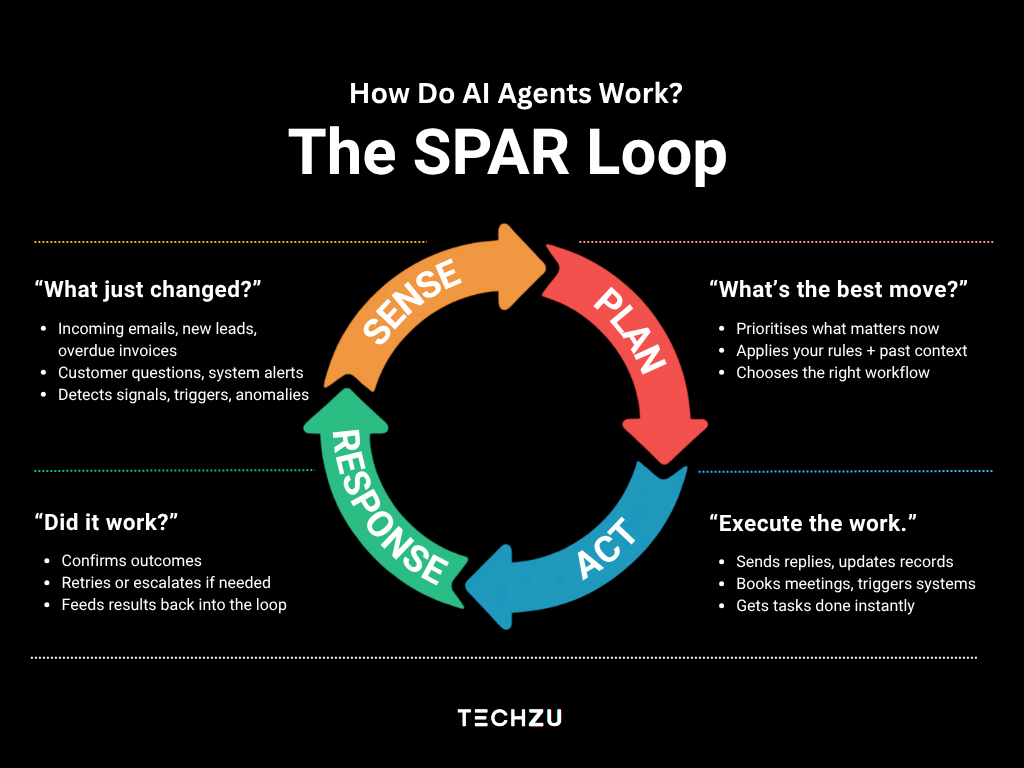
At the core of every AI agent is a simple loop that turns signals into action. The SPAR loop.
- Sense: The agent checks what’s happening, like when an email arrives, an invoice is due, a customer asks a question.
- Plan: It decides what to do based on your rules and its understanding of the situation.
- Act: It takes action: sends a reply, updates a spreadsheet, books an appointment.
- Respond: It checks whether the action succeeded and loops back to Sense to continue.
This autonomous, goal‑oriented behaviour is what makes agentic AI different from generative AI. Generative AI helps you create, but agentic AI helps you execute.
A Quick Note on Terminology
These three terms are often used interchangeably, but they mean slightly different things:
- Generative AI (GenAI): AI that creates new content (text, images, code). Think ChatGPT, Claude, Gemini.
- AI Agents: An umbrella term encompassing many types of automated systems.
- Agentic AI: A specific subset of AI agents that act autonomously toward a goal.
The Numbers: How Singapore SMEs Are Using AI
Let’s be honest about where Singapore SMEs actually stand.
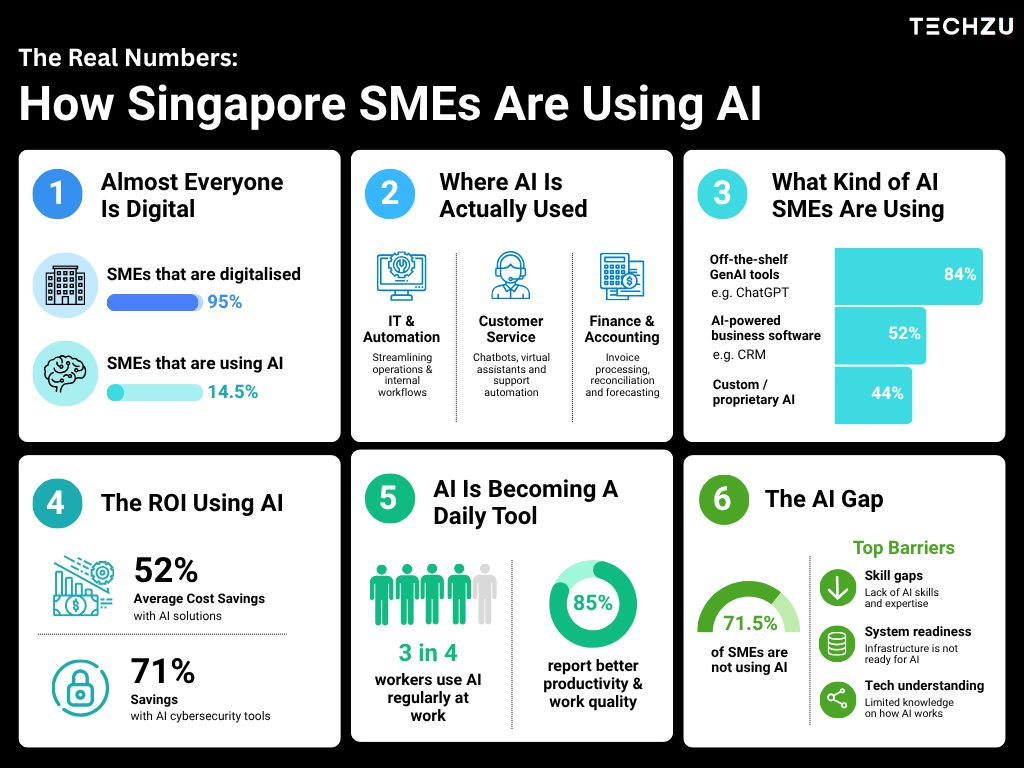
AI adoption here has moved fast. According to IMDA’s Singapore Digital Economy Report 2025, SMEs adopting AI in their business tripled in a single year to around 15%. Large enterprises are already at 62.5%. That gap tells you everything about the opportunity sitting on the table right now.
The businesses pulling ahead aren’t just using AI to create content. They’re using it to automate entire workflows: chasing invoices, qualifying leads, answering customer queries, booking appointments, without a human in the loop.
That’s the shift this guide is about. And when SMEs make that shift, the results are hard to ignore:
| What AI automation delivers for SMEs | Figure |
|---|---|
| Improved productivity/processes | 93% |
| Revenue increase | 29% |
| Cost reduction | 43% |
| Acquiring new customers | 38% |
These aren’t numbers from tech giants with million-dollar budgets. They’re from financing consultancies, retail operations, and service businesses, the same kinds of businesses you’re running, that made one decision: to stop doing repetitive work manually and let an AI agent handle it instead.
5 Actual AI Agent Benefits for Singapore SMEs
For most Singapore SME owners, the pitch for AI sounds great in theory. But the real question is simple: what does it actually do for me, and is it worth it? Here’s what the evidence shows.
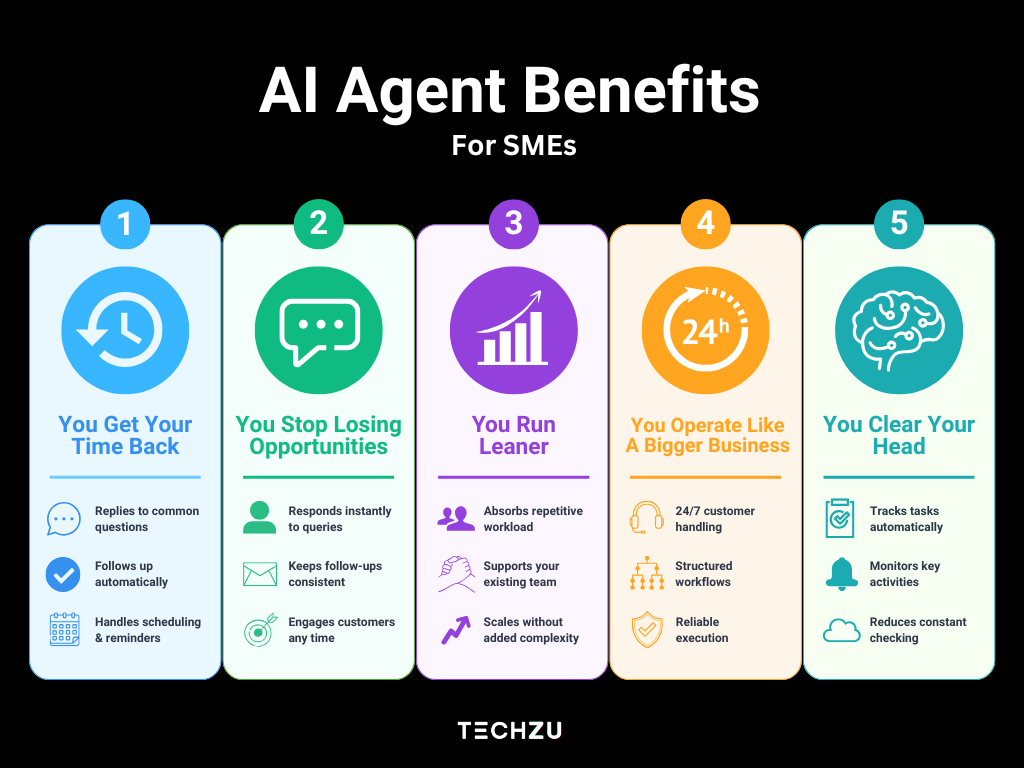
1. You Get Your Time Back

Time is the one thing you can’t hire more of. AI agents handle the work that fills your day but never moves your business forward, answering the same customer questions, chasing unpaid invoices, sorting through enquiries, scheduling appointments.
According to Salesforce’s SMB Trends Report, 90% of SME leaders using AI report more efficient operations. Intuit found that AI agents can save SMBs as much as 12 hours each month. That’s an entire working day every month you don’t have to spend on repetitive work.
2. Your Revenue Has Room to Grow

More time means more focus on the work that actually generates revenue. And the numbers back this up: 29.9% of Singapore SMEs report their revenue has gone up since adopting AI, according to the IMDA’s Singapore Digital Economy Report. It’s not magic, it’s compounding. When your follow-ups go out faster, your leads don’t go cold. When your customer queries are answered at 11pm on a Sunday, you don’t lose the sale to a competitor who responded first.
3. You Spend Less to Operate

Labour is one of the biggest costs for any SME. AI agents don’t replace your team, but they absorb the volume of repetitive work that would otherwise require additional headcount. Singapore SMEs using IMDA-approved AI solutions have reported an average cost saving of 52%. For a business already stretched thin, that’s significant.
4. You Compete on a More Even Footing

Large enterprises have always had an advantage: more people, more processes, more capacity. AI agents narrow that gap. A one-person operation can now have a system that handles customer service around the clock, qualifies leads automatically, and sends timely follow-ups, the kind of infrastructure that used to require an entire operations team.
5. You Reduce the Mental Load of Running a Business

This one doesn’t show up in statistics, but SME owners who have deployed agents consistently report it: less mental overhead. When you know an agent is monitoring your invoice due dates, your customer inbox, or your appointment calendar, you stop carrying those tasks in your head. That cognitive relief is underrated, and for many owners, it’s reason enough.
Real-Life Examples: How SMEs Are Putting AI Agents in Singapore to Work
The best way to understand what AI agents can do for your business is to see what they’re already doing for businesses like yours. Here are five AI agents use cases in Singapore today.
1. Customer Support

Linkflow Capital, a Singapore SME financing consultancy, deployed IntelWave’s AI chatbot to handle frontline customer queries. The result: roughly 70% of operational responses are now automated, saving the team around 40 man-hours a month. That’s a full working week, every single month, reclaimed from answering the same questions over and over.
The principle scales beyond one company. Haptik’s WhatsApp-based AI agent platform reports that early users resolved up to 80% of repetitive queries automatically, with a 20-25% increase in lead conversions on top. When your agent handles the routine, your team can handle more higher value tasks, such as relationship building and sales follow up.
2. Retail Experience

FairPrice Group worked with Google Cloud to deploy AI-powered smart carts, which are trolleys with multimodal AI assistants that help shoppers navigate aisles, scan barcodes, spot promotions, and receive personalised product suggestions in real time. Behind the scenes, the same agentic AI powers employee tools across HR, customer service, and store operations.
You don’t need to be FairPrice to benefit from this thinking. Singapore retailers are already using AI agents to forecast demand during festive periods, auto-reorder fast-moving stock, and flag inventory anomalies, without a human manually pulling reports.
3. Appointment Scheduling & Lead Management

For any service-based SME, a clinic, a consultancy, a real estate agency, missed follow-ups and scheduling gaps cost real money. AI agents can read natural language requests, check calendar availability across multiple team members, confirm bookings, and send reminders, all without a human in the loop.
Voice agents take this further: they can handle after-hours calls, manage patient or client reminders, and qualify inbound leads before routing them to your team the next morning. The lead that came in at 11pm gets a response before your competitor even opens their inbox.
4. Finance & HR

This is where Singapore SMEs have some of the most immediate, tangible wins available. A local hotel group that automated supplier invoice processing using AI reported a 95% reduction in overdue payments and an 80% cut in processing time. A law firm that used AI for document automation improved efficiency by up to 80%.
For HR, the gains are equally concrete. AI agents can screen job applications against your criteria, answer employee policy questions around the clock, schedule interviews, and even handle onboarding tasks, generating contracts, setting up system access, and scheduling first-week meetings automatically. SMEs reported saving 2-3 hours of HR and management time per new hire after automating their onboarding workflow.
Finance agents, meanwhile, can classify transactions, reconcile accounts, chase overdue invoices, and flag anomalies, the kind of work that currently falls on whoever has time, which is never the right answer.
5. Marketing and Sales

A lean marketing team can only do so much. AI agents are starting to change that equation, not by replacing everything at once, but by automating key decisions and actions across the marketing workflow.
Today, most SMEs don’t rely on a single all-in-one agent. Instead, they deploy AI-driven systems that work together, monitoring customer behaviour, triggering campaigns, and optimising performance in the background.
In practice, this means:
- Campaigns that adjust based on how users engage
- Systems that automatically segment audiences and trigger follow-ups
- Conversational agents that qualify leads and respond instantly
- Ad platforms that continuously optimise targeting, bidding, and spend
Tools like HubSpot and Salesforce already enable behaviour-based automation, while platforms such as Google Ads use AI to optimise campaigns in real time. Increasingly, these capabilities are being connected into agent-like workflows that require minimal manual intervention.
The results are measurable: AI-enhanced marketing has been shown to improve ROI by an estimated 12%. For an SME spending on paid ads or running promotions, that’s not a marginal gain, it’s a meaningful shift in efficiency and performance.
The common thread across all five areas: these are not exotic use cases requiring specialist engineers. They are repetitive, high-volume tasks that every SME owner recognises, and that AI agents are already handling reliably, affordably, and at scale.
How to Start Using AI Agents in Singapore: A Step‑by‑Step Roadmap
Most SME owners don’t struggle with a lack of AI options, they struggle with where to start. With so many possibilities, it’s easy to overcommit or delay action chasing the “perfect” setup.
The roadmap below shows a step-by-step guide to getting started.
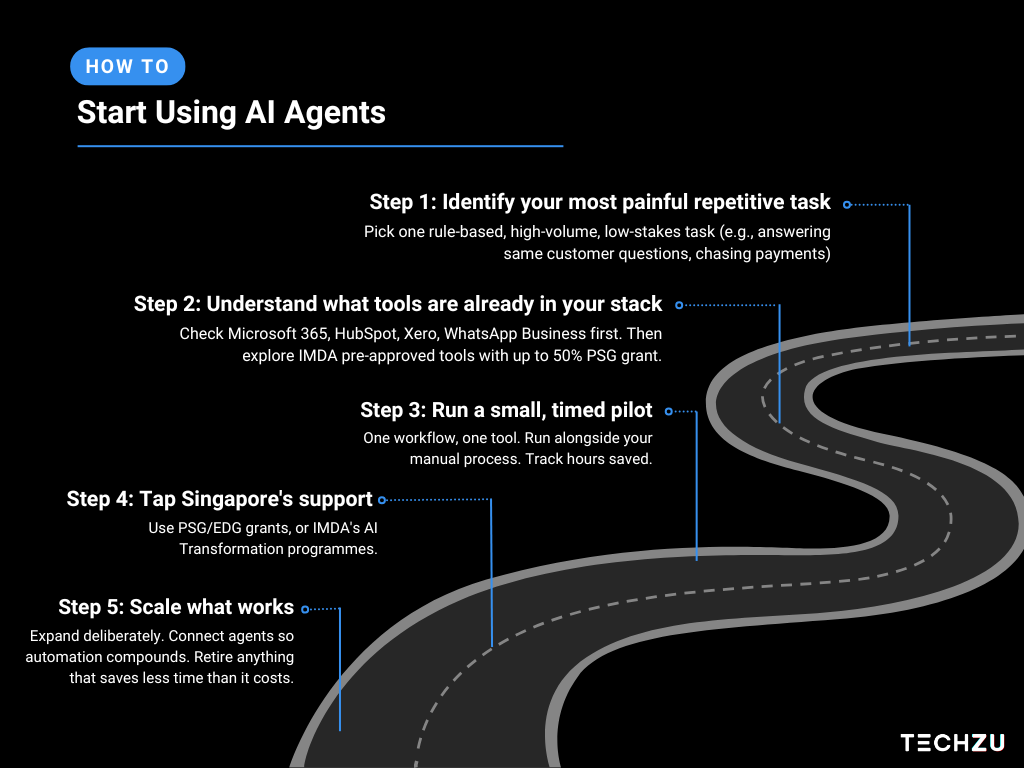
Step 1: Identify Your Most Painful Repetitive Task
Don’t start with technology. Start with a problem.
Ask yourself: what is the one task that eats your time every week, that you or your team does over and over, and that follows a predictable pattern?
Common answers from Singapore SMEs include:
- Responding to the same customer questions on WhatsApp or email
- Chasing clients for payments or documents
- Manually updating records after a booking or sale
- Sorting through job applications
- Generating quotes or proposals from a standard template
Write it down. That’s your starting point.
Don’t pick a task that requires complex judgement calls, sensitive client relationships, or creative strategy. Start with something rule-based, high-volume, and low-stakes if it occasionally goes wrong.
Step 2: Understand What Tools Are Already in Your Stack
Before buying anything new, look at what you already have.
Many SMEs in Singapore are already paying for tools with built-in AI capabilities they’ve never activated. Microsoft 365 includes Copilot features. HubSpot has AI-powered workflows. Xero offers automation for invoicing and reconciliation. WhatsApp Business can be connected to AI chatbot platforms with little setup.
Make a list of the tools your business currently uses. Then check whether any of them have an AI or automation feature you haven’t turned on. You may be closer to getting started than you think.
If you need to evaluate new tools, Singapore has a significant advantage: the IMDA’s SMEs Go Digital programme provides a pre-vetted list of AI solutions under its Artificial Intelligence and Data pre-approved vendor list. These tools have been assessed for reliability and come with PSG (Productivity Solutions Grant) co-funding of up to 50%, reducing the financial risk of trying something new considerably.
There is also a third option: building AI agents customised to your specific workflow. Many SMEs work with custom software developers to design custom agents that connect their existing tools or systems and automate end-to-end workflows more precisely.
Step 3: Run a Small, Timed Pilot
Don’t deploy company-wide. Whether you’re using an existing tool or a custom-built agent, start with one workflow, one approach, and a 30-day window to test it.
The goal of a pilot is not perfection. It’s learning. You want to find out:
- Does the agent handle the task reliably enough?
- How much setup and maintenance does it actually require?
- What edge cases does it miss, and how much does that matter?
- What did it save in time or cost over 30 days?
Measure it simply. Track how many hours that task took before the pilot. Track how many it took after. That’s your baseline ROI.
Tip: Run the agent in parallel with your existing process for the first week or two. Don’t switch off the manual workflow immediately. Let both run, compare outputs, and only hand over fully once you trust it.
Step 4: Tap Singapore’s Support Ecosystem
You don’t have to figure this out alone. Singapore has one of the most active SME AI support ecosystems in the region, and most business owners don’t use it nearly enough.
- Productivity Solutions Grant (PSG): Co-funds up to 50% of the cost of IMDA-approved AI and automation solutions. Apply through the Business Grants Portal. If you’re using a pre-approved vendor like Techzu, much of the setup and grant documentation is handled for you, making the process significantly easier.
- Enterprise Development Grant (EDG): Covers broader digital transformation projects, including custom AI agents development. Administered by Enterprise Singapore.
- IMDA’s AI Transformation Programme for SMEs: Provides structured guidance for SMEs moving from basic AI use to workflow automation, including access to consultants and solution demos.
- Enterprise Workforce Transformation Package (EWTP): The government’s most comprehensive grant for AI adoption in SMEs rolling out in 2026. It covers consultancy, internal capability building, and AI tools together, with up to 70% funding. Ideal if you want a proper end-to-end AI adoption plan rather than just funding a one-off tool purchase.
Beyond grants, many of the major banks operating in Singapore, including DBS, OCBC, and UOB, provide SME digitalisation support through advisory services and curated partner ecosystems that help businesses explore suitable automation solutions.
The financial support available means that the effective cost of a first AI agent deployment is often significantly lower than owners assume. Factor that in before deciding it’s not the right time.
Step 5: Scale What Works, Drop What Doesn’t
Once your first AI agent proves value, expand deliberately, either by scaling additional workflows in the same tool, or extending your custom AI agent to connect more systems.
The next agent you deploy should connect to the first. Workflow automation compounds: an agent that qualifies inbound leads becomes more powerful when it’s connected to an agent that books follow-up appointments, which feeds into an agent that sends onboarding materials on day one. Each addition multiplies the value of what’s already running.
At the same time, be ruthless about what isn’t working. Not every AI tool is worth maintaining. If an agent requires constant correction, generates more complaints than it resolves, or saves less time than the overhead of managing it, retire it.
A Realistic Timeline
A first AI agent pilot can often be implemented within six to eight weeks when the scope is clearly defined and focused on a single workflow. This is especially true when using existing tools or lightweight custom builds.
Here’s what that typically looks like:
| Week | Activity |
|---|---|
| 1 | Identify the target task, audit existing tools |
| 2 | Shortlist 2-3 solutions; check grant eligibility |
| 3-4 | Set up and configure your chosen tool |
| 5-6 | Run the pilot alongside your manual process |
| 7-8 | Evaluate results; decide whether to fully hand over and what to automate next |
The businesses that move fastest are not the ones who plan the most. They’re the ones who pick a specific problem, start small, and iterate.
However, timelines vary when custom AI agents are involved. Unlike off-the-shelf tools, custom builds depend on the number of systems involved, the complexity of the workflow, and how much refinement is needed during deployment.
A useful way to think about it is in three levels:
1. Simple custom AI agent (basic workflow automation)
Example: lead classification, automated email replies, and CRM updates
- Focused on a single workflow
- Limited system integrations
- Minimal custom logic or edge cases
2. Moderate complexity (common SME use case)
Example: sales follow-ups, booking automation, and CRM synchronisation
- Multiple systems connected
- More variation in workflows and edge cases
- Requires iterative testing and refinement
3. Complex custom agents (multi-department systems)
Example: automation spanning sales, operations, and finance
- Multiple interconnected workflows
- Data governance and reliability considerations
- Requires organisational change and process alignment
The key point is that timelines scale with complexity, not just with the technology itself.
Every week you delay, the gap between you and the 14.5% of Singapore SMEs already using AI widens. More importantly, it widens between you and the larger enterprises at 62.5% who have already automated workflows you’re still doing manually.
The question isn’t whether AI agents will matter for Singapore SMEs. They already do. The question is how long you want to wait before finding that out for yourself.
AI Agents Risks & Security: What Every SME Owner Must Know
In Singapore, AI adoption is supported by clear regulatory guidance from bodies like the Cyber Security Agency of Singapore (CSA). The key principle is simple: AI agents should be deployed with the same security and access controls as any other user in your organisation.
| Risks | What To Do |
|---|---|
| System Access & Data Exposure AI agents often require privileged access to databases, email, and financial systems. If compromised, this can expose sensitive customer or financial data. | Limit agent permissions from day one. Treat each AI agent as a tightly scoped “digital employee” with defined access boundaries. |
| Unsupervised Access Risk Over one-third of organisations flag unsupervised data access by AI agents as a critical threat. | Implement strict access controls and ensure agents only operate within approved workflows. |
| Visibility & Governance Gaps Nearly 50% of organisations report insufficient visibility and control over generative AI tools. | Use monitoring systems and audit logs to track all agent activity. Review logs regularly. |
| Data Loss & Misuse Concerns In Singapore, around 40% of organisations cite data loss via GenAI tools as a major concern, while 39% are concerned about sensitive data being used in AI training. | Classify sensitive data before granting access. Use tools like Microsoft Purview sensitivity labels or Google Workspace DLP. |
| Operational Safety Without oversight, AI agents may take unintended actions in sensitive workflows. | Keep humans in the loop for high-risk or irreversible actions. |
| Security & Compliance Weak identity controls can allow agents to overstep intended permissions. | Implement fine-grained identity and access management. Ensure agents never exceed the access level of the human they support. |
| Early Deployment Risks Poorly tested agents can behave unpredictably in real environments. | Use sandboxed environments and isolated test systems before full deployment. |
| Governance Guidance Many SMEs are unaware of structured AI governance frameworks. | Refer to CSA’s Securing Agentic AI Discussion Paper for security checklists and deployment guidance. |
Singapore SME Grants Available for AI Implementation
The effective cost of deploying your first AI agent is almost always lower than you expect, because Singapore has layered grant support specifically for this. Here are some of the most relevant grants:
Productivity Solutions Grant (PSG)
PSG is your starting point if you’re adopting an off-the-shelf AI tool. It supports sector-specific and generic solutions pre-approved by EnterpriseSG and other participating agencies, covering up to 50% of costs, capped at S$30,000.
PSG now includes GenAI-based solutions for marketing, sales, and customer engagement, which are solutions tested under the GenAI Sandbox for SMEs launched by EnterpriseSG and IMDA. If a vendor is on the pre-approved list, the path to funding is straightforward.
To qualify, your business must be:
- registered and operating in Singapore
- have at least 30% local shareholding
- have an annual turnover below S$100 million or fewer than 200 employees.
Your business must not have signed any contract or made any payment before your application is approved.
Enterprise Development Grant (EDG)
EDG is the right grant when off-the-shelf tools don’t fit your workflow. If you need something built specifically for your operations, like a workflow automation platform, a custom AI-powered system, or something that connects tools that weren’t designed to talk to each other, EDG is the better fit.
It covers up to 50% costs for SMEs on:
- third-party consultancy fees
- software and equipment
- Internal manpower costs
The important thing to understand is that EDG is a strategic grant, not a reimbursement scheme. Approval depends far more on how a project is designed and justified than on the forms themselves. A focused, well-scoped project with measurable outcomes will consistently outperform a vague, ambitious one.
Apply before committing to the project, not midway through.
SkillsFuture Enterprise Credit (SFEC)
SFEC is automatically awarded. No application needed. If you qualify, Enterprise Singapore notifies you by email. Simply log into the Business Grants Portal with your Corppass and you’ll see an SFEC banner showing your S$10,000 balance.
To qualify, your company must be registered in Singapore with at least three resident employees (Singapore Citizens or PRs) who have been on CPF for at least six months.
The credit pays up to 90% of your remaining out-of-pocket costs after other grants have already reduced your bill. You use PSG or EDG first, then SFEC covers most of what’s left. It can be used across:
- enterprise transformation programmes
- workforce training
- job redesign initiatives
This means the cost of upskilling your team to manage and use AI agents is largely covered too.
NTUC CTC Grant
The CTC Grant is less well-known than PSG or EDG, but for SMEs deploying AI alongside genuine workforce change, it can be the most generous of the three. It:
- funds up to 70% of project costs for SMEs (capped at S$250,000 per project)
- covers equipment, software, consultancy and related training, provided the project delivers both enterprise transformation and workforce outcomes like improved productivity gains or business outcomes
The grant is structured around the idea that AI should upgrade your workforce, not replace it.
Enterprise Workforce Transformation Package (EWTP)
EWTP is the Singapore government’s biggest upcoming workforce funding initiative, with over $400 million set aside to help businesses manage the human side of AI adoption.
Think of it this way: most grants help you buy AI tools. EWTP helps you prepare your people for them, by redesigning roles affected by AI, training your managers and HR teams, and making the transition smoother for everyone.
Here’s what it offers:
- Up to 70% funding for workforce transformation and job redesign costs
- Capped at $150,000 per enterprise (higher than most other grants)
- One application covers everything. No juggling multiple schemes.
It rolls out in phases through 2026.
The redesigned SFEC also launches under EWTP: all companies with at least three resident employees will receive a new $10,000 credit, available in the second half of 2026. This means that if you’ve already used your current SFEC, you will receive a new one.
Singapore SME Grants for AI: At a Glance
| Grant | Best for | Max. Support |
|---|---|---|
| PSG | Pre-approved off-the-shelf AI tools | Up to S$30,000 (50%) |
| EDG | Custom AI agent builds | Up to 50% of project costs |
| SFEC | AI training and tooling top-up | S$10,000 (up to 90% of remaining costs) |
| CTC | AI + workforce transformation together | Up to S$250,000 (70%) |
| EWTP | Job redesign and workforce transition for AI | Up to S$150,000 (70%) |
Most SME AI deployments can draw from more than one of these simultaneously because each covers a different category of cost. PSG funds the tool, EDG funds the custom build, SFEC reduces what’s left, and the CTC Grant or EWTP cover the workforce transition that should accompany any serious deployment. The pre-approved vendor list for PSG changes periodically, so always check GoBusiness before selecting a tool.
Our Take:
We recommend EWTP for SMEs looking to adopt AI in their business. This grant allows SMEs to engage Consultancy, Capability Building and AI Solutions. This holistic approach will ensure a clear AI adoption plan and success, creating true business value.
For SMEs looking to access EWTP, we partner with BDO Singapore as our appointed programme partner. More details on EWTP can be found on the WSG factsheet.
Conclusion
The window of opportunity is wide open. AI adoption among Singapore SMEs is still low, at 14.5%, which means early adopters have a real first‑mover advantage.
The compound effect of five or ten agents quietly running your back office, customer service, and marketing can be genuinely transformative. AI agents won’t replace your team, they’ll free your team to do what they do best: build relationships, solve complex problems, and grow your business together.
If you’re looking for an expert team to build AI agents for your SME, Techzu’s AI software development services are built for exactly this kind of work and will handle everything from grants to compliance to development.
About Techzu
Techzu is an award-winning digital partner helping Singapore SMEs automate, grow, and compete with cost-effective, ROI-driven solutions in AI, automation, website development, and custom software, backed by 120+ successful projects for 80+ clients across multiple industries.
FAQ
Applications that observe your business, make decisions, and take action automatically with minimal human input.
Using the SPAR loop: Sense, Plan, Act, Respond.
AI agents include chatbots that handle customer support, recommendation systems that personalize content or products, fraud detection systems that flag suspicious activity, and autonomous assistants that manage tasks like scheduling, reporting, or workflows.
Generative AI creates content like text, images, or code based on prompts. Agentic AI goes further by using AI to make decisions and take actions, often combining multiple steps and tools to achieve a goal with minimal human input.
Yes, adoption in AI tripled to about 15%, but fewer than 1 in 7 are using it.
About 29% of Singapore SMEs report increased revenue, over 90% say it saves them time, and many achieve around 43% cost reduction.
Identify your most painful repetitive task (e.g., answering the same customer questions, chasing invoices).
Data exposure, unsupervised access, governance gaps, and operational safety. These can be managed by limiting access permissions, keeping humans in the loop for sensitive tasks, using monitoring and audit logs, and testing agents in controlled environments before full deployment.
Yes. Techzu builds custom AI agents for Singapore SMEs, handling everything from grants to compliance.
We partner with consultants to document workflows, deliver in phases, disclose recurring costs upfront, and focus every feature on business value.
PSG (up to 50% co-funding for IMDA-approved solutions) and CTC & EDG for custom development.
Use off-the-shelf software if your processes are simple. Go custom when your workflow is unique and disconnected tools aren’t working.
The Enterprise Workforce Transformation Package (EWTP) is a good government-supported option for Singapore SMEs exploring AI adoption, especially for businesses looking to transform their workforce, redesign jobs, and improve productivity.
Start by auditing your existing tools. Many software tools come with built-in AI features that haven’t been activated, like Microsoft 365 Copilot, HubSpot AI workflows, or Xero automation.