
Your team is running on spreadsheets, WhatsApp groups and three subscriptions that don’t talk to each other. Do you buy yet another tool, or build a custom software that fits?
At Techzu, we design and build software for Singapore SMEs almost every day. Most of our custom software clients started with the same setup you may have right now: Google Sheets, Excel, WhatsApp, or paper, holding the business together.
So how do you decide? To help you make the right decision, we compare both custom software vs off-the-shelf options, their costs, government grants, and real examples from Singapore businesses.
The short answer: Custom software vs off-the-shelf
Buy off-the-shelf software for standard business tasks such as accounting, payroll and email. Develop custom software when your business has unique workflows (like managing customer bookings, payments and follow-ups in one place), needs several systems to work together, or you’re spending too much time on manual workarounds. Sometimes, a combination of both can also work well, by developming custom software to connect existing off-the-shelf tools and make them work together seamlessly.
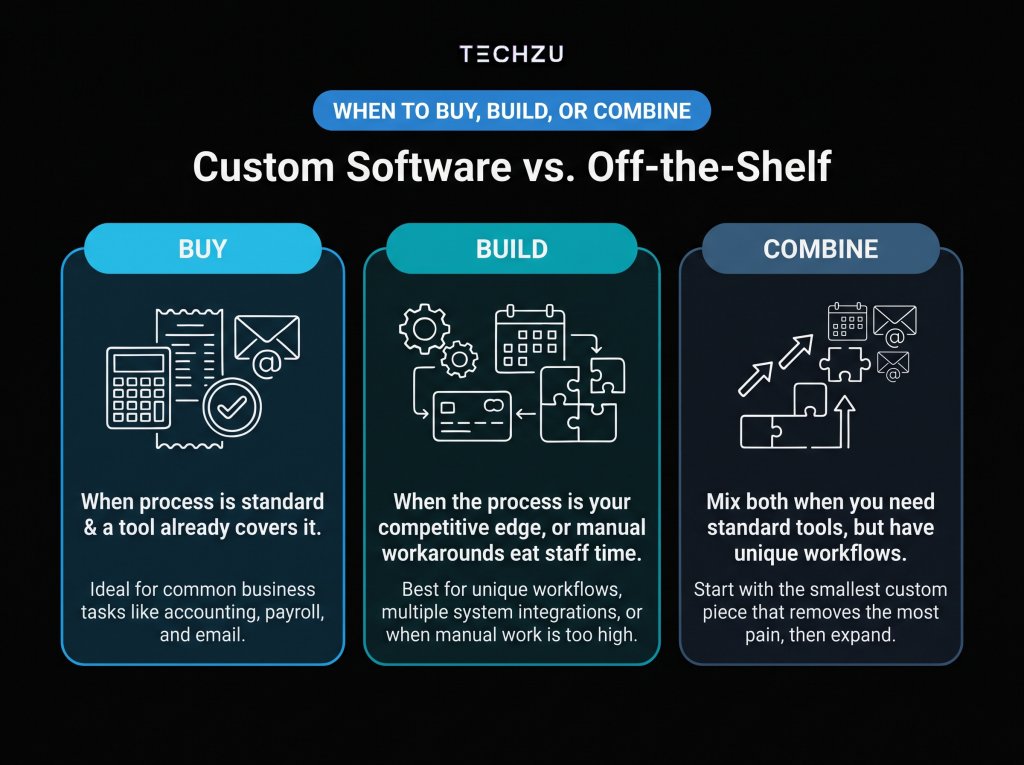
What is off-the-shelf software and what is custom software?
Off-the-shelf software is a ready-made product built for many businesses, such as Xero, HubSpot, or Microsoft 365. Custom software is built for one business, around the way that business actually works. Here is how the main types differ:
- Off-the-shelf: You subscribe, configure settings and start. You cannot change how it works inside.
- Custom software: Designed, built and tested for your processes, users and systems. You decide the features and workflows.
💡 Configurable platforms: Off-the-shelf tools with plug-ins, workflows or an add-on marketplace. They stretch further, but only within the vendor’s limits.

Main differences between custom software and off-the-shelf solutions
The main differences between custom and off-the-shelf software come down to four things:
- Cost and setup time: Off-the-shelf software is usually cheaper to start with and can be set up within days or weeks. Custom software requires a larger upfront investment and typically takes several months to develop.
- Flexibility: Off-the-shelf tools offer standard features that you configure to suit your needs. Custom software is built around your specific workflows and requirements.
- Integration and scalability: Ready-made tools are limited to the integrations and plans offered by their providers. Custom software can connect your existing systems and be extended as your business needs change.
- Ownership and maintenance: With off-the-shelf software, the provider controls the product, updates and pricing. With custom software, ownership depends on your contract, and you are responsible for arranging ongoing maintenance.
For Singapore SMEs looking to explore ready-made solutions, IMDA’s SMEs Go Digital platform provides digital advisory and access to pre-approved solutions. First-time use of the advisory service has been offered at no cost to eligible SMEs!
Bespoke software vs Off-the-shelf: Pros and cons for Singapore SME
Off-the-shelf software is cheaper and faster to start, but you adapt to it and often pay more as your team grows. Custom software development fits your process and avoids per-user fees, but it costs more upfront and needs someone to maintain it.
| Off-the-shelf | Custom software | |
|---|---|---|
| Main pros | • Quick to set up and start using • Low entry cost • Vendor handles updates and support • Reviews and free trials let you test first | • Built around your workflow • Connects to the tools you already use • No per-seat fees • Can become a point of difference |
| Main cons | • Features you never use, and gaps you need • Rigid workflows • Competitors can buy the same tool • Vendor sets the price and roadmap | • Higher upfront cost • Takes months • Needs ongoing maintenance • Depends on your developer |
| Hidden costs | • Extra seats and plan upgrades • Connectors between tools • Staff hours spent on workarounds • Migration if you switch vendors | • Hosting and security updates • Bug fixes and small improvements • Documentation • Training new staff on the system |
The hidden costs are where decisions go wrong. A subscription looks cheap until you add the spreadsheet workarounds around it. A custom build looks expensive until you count what the workarounds cost every year.
For example, a Singapore retailer of water purification systems approached Techzu because its leads were managed through Google Sheets and WhatsApp. Although a ready-made CRM could handle basic lead tracking, the business also needed automatic lead assignment across different salesperson tiers, quotations linked to live stock, installation scheduling and a customer portal for warranties and servicing.
We developed a customer lifecycle management system that brought these processes together, resulting in zero unclaimed leads and real-time sales forecasts and commission reports.

What are the disadvantages of an off-the-shelf Enterprise Resource Planning (ERP) system?
An off-the-shelf ERP system may be quicker to implement, but it comes with limitations:
- Limited customisation: Your business may need to adjust its workflows to fit the ERP system.
- Unnecessary features: You may pay for modules and functions your company rarely uses.
- Integration challenges: Connecting the ERP to existing business systems may require additional tools or paid integrations.
- Rising costs: Subscription fees, additional user licences and upgrades can increase as your business grows.
- Vendor dependency: You rely on the provider for product updates, pricing, support and available features.
For Singapore SMEs with specialised workflows, these limitations can make a ready-made ERP system less suitable as business operations become more complex.
How much does custom software development cost in Singapore?
Based on Techzu’s 2025 market data, custom software development in Singapore typically costs between $20,000 and $350,000, depending on the system’s complexity.
| System size | Typical cost (SGD) | What you get |
|---|---|---|
| Small | $20,000 – $40,000 | Simple internal tools with basic data entry and reporting |
| Mid-size (most SMEs) | $50,000 – $150,000 | Multiple workflows, user roles and automation |
| Large | $200,000 – $350,000 | End-to-end business operations |
Most projects take approximately 3 – 12 months, depending on the scope and number of features.
What are the costs beyond custom software development?
Many SMEs focus on the build price and underestimate what it takes to keep the system running. Plan for:
- Maintenance: updates, bug fixes and small improvements, about 15-20% of build cost per year
- Hosting: cloud servers and storage
- Testing and quality checks when you add features
- Compliance work, if your industry needs it
What does a 5-year price comparison look like?
Comparing the initial purchase price alone can be misleading. Here’s an example of a 25-person SME using three separate subscriptions compared with one custom system.
| Cost item | Buy: 3 tools patched together | Build: one custom system |
|---|---|---|
| Build cost | S$0 | S$90,000 |
| Subscriptions (3 tools x 25 users x S$30/month) | S$27,000 a year | S$0 |
| Workarounds (10 staff hours a week at S$25/hour) | S$13,000 a year | S$0 (assumed) |
| Maintenance (18%) and hosting | S$0 | S$19,200 a year |
| Running cost per year | S$40,000 | S$19,200 |
| Total over 5 years | S$200,000 | S$186,000 |
In this example, the difference is only around 7%. However, if the business grows to 40 employees, subscription costs alone increase to approximately S$43,200 annually, while custom software running costs may remain relatively stable.
If one ready-made tool already covers your needs, buying is usually cheaper. Custom development becomes more attractive when multiple subscriptions overlap, manual workarounds consume staff time or per-user fees keep increasing.
| What if you didn’t have to pay extra for hosting every year? Techzu includes free lifetime hosting, SEO foundation setup and an AI agent with every custom software solution, helping you reduce ongoing costs while getting more out of your investment. Discuss your custom software project with Techzu. |
Are there any Singapore SME grants to help pay for your software?
Yes. Singapore’s EDGE Grant replaced the Enterprise Development Grant (EDG), Productivity Solutions Grant (PSG) and Market Readiness Assistance (MRA) Grant for new applications from 30 September 2026. Companies can receive up to $100,000 per year across eligible activities, with up to $30,000 allocated to single-function digital solutions, integrated enterprise systems and selected automation activities.

What custom software development projects does EDGE cover?
EDGE covers over 150 activities across 8 business areas. For software, the activity groups that matter most are below:
| Your software need | EDGE activity group |
|---|---|
| Ready-made software that does one job (off-the-shelf) | Single-function digital solutions |
| One platform joining several business functions | Integrated enterprise systems |
| Customised, enterprise-wide automation | Large-scale automation |
| A bigger change programme | Large-scale digital transformation |
| Cybersecurity or data protection certification | Digitalisation standards |
Who is eligible for EDGE, and how does payment work?
- Eligibility: a business registered in Singapore with at least 30% owned by Singapore citizens and/or permanent residents. Other conditions may apply by activity.
- Support rate: it varies by activity.
- Payment: EDGE is paid on a reimbursement basis. You submit claims after the project is completed and fully paid.
- Past grants: if you received EDG, PSG or MRA before, you can still apply for EDGE.
- SkillsFuture Enterprise Credit: EDGE cannot be combined with it.
Apply and wait for approval before signing a contract or paying a deposit. Costs incurred before approval may not qualify.
| Not sure which activity fits your project? Techzu offers to check your company’s eligibility if you get in touch. |
Does PDPA affect custom software vs off-the-shelf decision?
Yes. Under Singapore’s Personal Data Protection Act (PDPA), Singapore SMEs remain responsible for protecting personal data, whether it is stored in an off-the-shelf platform or custom-built system. The main difference is how much control you have over the data, hosting and security arrangements.
The PDPA applies to SMEs that collect, use or disclose personal data in Singapore. There is no general exemption for small businesses. The Personal Data Protection Commission (PDPC) recommends four basic practices under B.E.S.T.:
- Back up important data.
- Encrypt sensitive information.
- Strengthen access controls.
- Track data assets and apply security patches promptly.
Questions to Ask Your Custom Software Firm about Data Protection
Before choosing a software provider or developer, ask about your custom software or off-the-shelf solution’s data and security:
- Where is your data hosted?
- Who can access it, and are access activities logged?
- Is information encrypted during storage and transmission?
- How quickly will you be notified of a data breach?
- Can you export and retrieve your data when leaving the provider?
- Do subcontractors have access to your information?
With custom software, you can tailor user access permissions to your business needs, such as allowing employees to view only the customer records relevant to their roles and tracking who accesses or changes sensitive information. Off-the-shelf software may already offer these security features, but you may have less flexibility to customise them. Either way, make sure the provider’s security responsibilities and data protection arrangements are clearly documented in your contract.
For example, Techzu developed a custom corporate secretarial system for a Singapore corporate secretarial firm that previously managed client records across Excel, OneDrive, WhatsApp and email. The new platform introduced individual client logins, organised document folders and activity logs to ensure users could access only the information relevant to them.

What is at stake if something goes wrong?
The PDPC can impose financial penalties of up to 10% of annual turnover or S$1 million, whichever is higher. A breach affecting more than 500 individuals counts as large-scale. Per the PDPC’s breach landscape report, cyber incidents are the leading cause of data breaches, and ransomware accounts for most of those.
What Singapore-Specific Requirements Should Your Business Software Meet?
Whether you buy off-the-shelf software or build a custom system, your business software needs to support Singapore’s local requirements. However, for standard functions such as accounting, GST reporting and payroll, ready-made solutions are usually sufficient. Here’s what to check before choosing.

1. GST and InvoiceNow: Is Your Accounting Software Ready?
InvoiceNow is Singapore’s nationwide e-invoicing network, built on the Peppol framework. It allows businesses to send and receive invoices digitally. Under IRAS’s InvoiceNow requirements, GST-registered businesses will progressively need to use InvoiceNow-ready solutions to transmit invoice data directly to IRAS.
| Implementation date | Businesses affected |
|---|---|
| 1 November 2025 | Newly incorporated companies that voluntarily register for GST within six months of incorporation |
| 1 April 2026 | All businesses that voluntarily register for GST, regardless of incorporation date or business structure |
| 1 April 2028 | New compulsory GST registrants and existing GST-registered businesses with annual supplies of S$200,000 or less |
| 1 April 2029 | Existing GST-registered businesses with annual supplies of S$1 million or less |
| 1 April 2030 | Existing GST-registered businesses with annual supplies of S$4 million or less |
| 1 April 2031 | Existing GST-registered businesses with annual supplies above S$4 million |
If you’re choosing accounting software, check that it is on IMDA’s accredited InvoiceNow-Ready Solutions list. You’ll also need a Peppol ID linked to your business’s UEN and must activate the feature for submitting invoice data to IRAS.
If your business uses an internally developed accounting system, you can still comply. However, you’ll need to work with an IMDA-accredited Access Point Provider to connect your system to InvoiceNow and IRAS.

2. GST Record-Keeping: Can You Retrieve Your Records for Five Years?
Under IRAS requirements, GST-registered businesses must retain their accounting and business records for at least five years from the end of the relevant accounting period. This includes sales and purchase invoices, receipts, credit notes, bank statements and accounting schedules.
Before choosing accounting software, check whether it allows you to:
- Store and retrieve invoices, receipts and supporting documents.
- Generate sales and purchase reports for GST submissions.
- Export your accounting records when switching to another provider.
- Retain access to historical records even after cancelling your subscription.
This is particularly important if you plan to change software providers. You don’t necessarily need to migrate all historical transactions into your new system, but you must retain the old records and be able to produce them when IRAS requests them.

3. Payroll: Does Your Software Support CPF and IRAS Submissions?
If you employ Singapore Citizens or Permanent Residents, your payroll system needs to account for CPF contributions based on the applicable rates and employee eligibility. CPF contributions are due by the last day of each calendar month. Employers who fail to pay by the 14th of the following month may face enforcement action and late payment interest of 1.5% per month.
Your payroll software should also support Singapore’s tax reporting requirements. For example, employers under the Auto-Inclusion Scheme (AIS) must submit their employees’ employment income information electronically to IRAS by 1 March each year.
Before subscribing, check whether the payroll solution supports:
- CPF contribution calculations and submission.
- IRAS Auto-Inclusion Scheme (AIS) submissions, including IR8A and applicable appendices.
- Employment income records and tax clearance submissions where required.
You can refer to IRAS’s AIS payroll software guidance to find compatible solutions.
So, should you buy or build?
For accounting, GST and payroll, buying established software that already supports Singapore’s regulatory requirements is usually the more practical option. Custom development makes more sense when you need additional business workflows, integrations or automation that existing solutions cannot provide. You can also connect custom-built systems to existing accounting and payroll software instead of rebuilding these functions from scratch.

So how do you actually decide between custom software vs off-the-shelf software?
Answer seven questions about one business process. If most answers sit in the “Buy” column, choose off-the-shelf. If most sit in the “Build” column, look at custom or a hybrid.
| Question | Buy | Build |
|---|---|---|
| Is this process the same as in other companies in your industry? | Yes | No, it is why customers choose you |
| How much of it happens outside your tools today (spreadsheets, WhatsApp, paper)? | Very little | A lot |
| How many systems must share data with it? | One or none | Three or more |
| How many people use it, and how fast is that growing? | A handful, stable | Growing, with per-user fees rising |
| What will licences cost over 3 years? | Low and predictable | High and climbing |
| Can someone own and maintain it after launch? | No one available | Yes, in-house or a partner under contract |
| Do you need it running this month? | Yes | No, you can phase it in |
How big does a business need to be before custom makes sense?
There is no fixed employee count. However, based on Techzu’s experience, Singapore SMEs with around eight or more employees may start feeling the limitations of spreadsheets and disconnected tools.
What is the best first step?
Start by mapping your existing business process. Identify which tasks are standard, which are unique and where your team spends the most time on manual work. Then choose ready-made tools for standard tasks and consider custom software for the biggest operational gaps.
What custom software do real Singapore SMEs build and buy?
Below are four Singapore SMEs Techzu have built custom software solutions for. In each case, the business had outgrown spreadsheets, chat groups or manual routines and needed something shaped around how it actually works.

1. Bubble tea chain: Integrated ordering and loyalty system
The business needed to manage loyalty programmes and orders across multiple outlets and channels. Techzu developed an integrated platform connecting its mobile app, self-order kiosks, POS and delivery services. Customers could earn and redeem rewards across channels, while management gained a combined view of sales.

2. Water purification retailer: Customer lifecycle management
Leads were previously managed through spreadsheets and WhatsApp, with sales assignments handled manually. We developed a system covering lead capture, automatic assignment, quotations, stock checks, installation scheduling and customer servicing. The result included zero unclaimed leads and real-time sales forecasts.

3. Corporate secretarial firm: Automated compliance management
The firm relied on Excel, OneDrive, WhatsApp and email to manage client records and compliance deadlines. We built a centralised platform with client portals, e-signatures, automated compliance alerts and bulk document generation. Tasks that previously took much of an afternoon could be completed in minutes.

4. Air-conditioning contractor: Field service management
The contractor struggled with manual scheduling, inventory tracking and contract renewals. We developed a system that connects job scheduling, technician availability, customer service history, inventory, invoicing and renewal tracking. The business gained real-time operational visibility and eliminated missed contract renewals
These examples show that custom software does not have to replace every existing tool. It should solve the processes that existing tools cannot handle effectively.
What is the hybrid approach to software, and is it right for you?
A hybrid approach combines ready-made, off-the-shelf software with custom development. You buy established tools for standard tasks and build only the features or integrations your business needs. For most SMEs, this can be a practical way to control costs without sacrificing flexibility.
| Business need | Buy | Build |
|---|---|---|
| Accounting and invoicing | Yes | |
| Payroll and HR basics | Yes | |
| Email, chat and documents | Yes | |
| Customer portal on top of your data | Yes | |
| Automation between your tools | Yes | |
| Your unique workflow (scheduling, quoting, compliance) | Yes | |
| Reports that combine several systems | Yes |
You can see this in practice in our own projects. The aircon contractor’s field service system syncs invoices with its existing accounting. The bubble tea chain’s ordering platform plugs into the WhatsApp Business API and Stripe instead of reinventing them. In both cases, we built a custom software that sat on top of tools that were already good at their jobs.
How do you start small?
You do not need to develop an entire business platform at once.
- Map your current workflow.
- Identify the biggest operational problem.
- Build the smallest useful solution.
- Measure the time saved and errors reduced.
- Expand only when the first phase proves its value.
How do you choose a custom software development company in Singapore?
Choose a custom software development firm who understands your business operations, not just the technology you want to build. Look for a team with experience developing similar systems for Singapore SMEs, a clear development process, and the ability to support your software after launch. Before committing, review their past projects, understand who will handle development and maintenance, and make sure project scope, source code ownership, costs and ongoing support are clearly stated in the contract.
What should the contract say?
- Scope and milestones: Define deliverables and approval requirements for each phase.
- Source code ownership: Confirm that your business owns the source code and the data.
- System access: Keep cloud accounts and code repositories under your company’s control.
- Maintenance: Agree on annual costs and response times after launch.
- PDPA: Document data protection, breach notice and data return on exit.
- Exit arrangements: Ensure another developer can take over, with proper documentation.
What does a good process look like?
Our own custom software projects follow seven stages: process discovery, system design with clickable mockups, development, user acceptance testing with your real data, deployment, training, and ongoing enhancements. You should be able to see working versions along the way, and test a design before any code is written.
What should you ask a custom software development company before signing?
- Can I see two or three projects for Singapore SMEs like mine?
- Who will actually build it, and who do I call after launch?
- How do you handle changes once the scope is agreed?
- Do I get the code, the data and the cloud accounts?
- Can you help me check EDGE Grant eligibility before I commit?
For more, read our guide on how to choose a custom software development company.

What can go wrong with custom or off-the-shelf software?
Custom projects usually fail because the scope was unclear. Off-the-shelf tools usually disappoint because of poor fit and creeping costs. Both are avoidable if you plan for them before you commit.
| Risk | Hits | What it looks like | How to reduce it |
|---|---|---|---|
| Unclear process | Custom | You build software around a messy process, and automate the mess | Map and simplify the process first |
| Doing too much at once | Custom | A big-bang build that runs late and over budget | Phase it, starting with the smallest useful piece |
| Key-person dependency | Custom | Only one developer understands the system | Documentation, code ownership, and a support plan |
| Forgotten maintenance | Custom | Budget covers the build but not the upkeep | Plan 15-20% a year |
| Price rises | Off-the-shelf | Subscriptions climb after you are locked in | Review contracts yearly. Cap increases where you can |
| Unused licences | Off-the-shelf | You pay for seats nobody uses | Audit seats every quarter |
| Poor fit | Off-the-shelf | Staff keep working outside the tool | Test with real workflows during the free trial |
| Vendor lock-in | Both | Moving your data out is hard or costly | Check export options before you sign |
In our experience, projects fail from “mismatched expectations, unclear processes, or trying to do too much at once.” None of those are technology problems. They are planning problems.

Can AI Agents Help Your Business, and Should You Buy or Build One?
Yes. AI agents can help SMEs reduce repetitive work by handling tasks such as responding to customer enquiries, qualifying sales leads, answering HR questions and retrieving financial information. You can buy an existing AI tool for common tasks or build a custom AI agent when your business needs more specific workflows or integrations. The right choice depends on what you want to automate and how closely an existing tool fits your operations.
Buying an existing AI tool makes sense when:
- You need common website development features such as website chat, email assistance or basic customer support.
- Your processes are relatively straightforward.
- The tool integrates with the software your business already uses.
- You want to get started without a large upfront development cost.
- Building a custom AI agent may make more sense when:
- Your business has specific workflows that generic AI tools cannot handle.
- The agent needs to retrieve information from multiple business systems.
- You need it to follow your internal processes, rules and approval steps.
- You want greater control over how it handles business information and customer interactions.
For example, a standard AI chatbot may answer general questions about your products. A custom AI sales agent could go further by checking product information, qualifying enquiries and passing promising leads to the right salesperson.
The important thing is to start with a clear business problem rather than adopting AI simply because it is available. Identify the task you want to improve, check whether an existing tool can handle it, and consider custom development only when your requirements go beyond what ready-made solutions offer.
| Looking to explore how AI agents can help you with your work? Techzu develops AI agents for Singapore SMEs across sales, HR, finance and customer support. Whether you need to automate customer enquiries, assist employees with internal queries or streamline repetitive business tasks, we can help you explore an AI solution built around how your business operates. Talk to us → |
FAQs on Custom Software vs Off-the-Shelf
It can be beneficial to have custom software for small businesses in Singapore when your process is unique or you are patching several tools together. In our experience, Singapore SMEs with about 8 or more employees usually start to feel the need. If one off-the-shelf tool already covers the job, buying is usually cheaper and faster.
Developing bespoke software offers several benefits for Singapore businesses:
• Tailored workflows: Build features around your business processes instead of adapting to the limitations of ready-made tools.
• Greater efficiency: Automate repetitive tasks, reduce manual data entry and minimise human errors.
• Seamless integration: Connect existing systems such as CRM, accounting, inventory and payment platforms.
• Scalability: Add new features, users and integrations as your business grows.
• Better control: Have greater flexibility over software features, data access and security arrangements.
• Long-term cost savings: Reduce reliance on multiple subscriptions, additional user licences and disconnected tools.
For Singapore SMEs, bespoke software can be particularly valuable when existing solutions no longer support their operational needs or business growth.
Possibly. Enterprise Singapore’s EDGE Grant replaced EDG, PSG and MRA from 30 September 2026. It offers up to S$100,000 a year per company, with support rates that vary by activity. Check the activity page and get approval before you sign or pay.
Based on Techzu’s 2025 market data, a mid-size SME system typically costs $50,000 – $150,000. Small internal tools start around $20,000 – $40,000, and large end-to-end systems run $200,000 – $350,000. Your scope decides the final figure.
Typically 3 to 12 months, depending on complexity and the number of features. Phasing the work lets you start using the first pieces much sooner.
Yes. You remain accountable for personal data whether a vendor hosts it or you do. Penalties can reach 10% of annual turnover or S$1 million, whichever is higher, so put data protection into every contract.
Not sure if a custom software solution or off-the-shelf fits your business?
Talk to us before you commit to a subscription or a custom software solution. Techzu offers custom software development services in Singapore that will look at how your team works today, tell you honestly which parts to buy and which to build, and check whether EDGE Grant support may apply.