
What is Business Digitalisation?
At its simplest, business digitalisation means using digital technologies to change how your business operates, communicates, and makes money. It is the shift from doing things manually or on paper to letting connected digital systems handle the work.
It is the second step in a company’s digital growth journey.
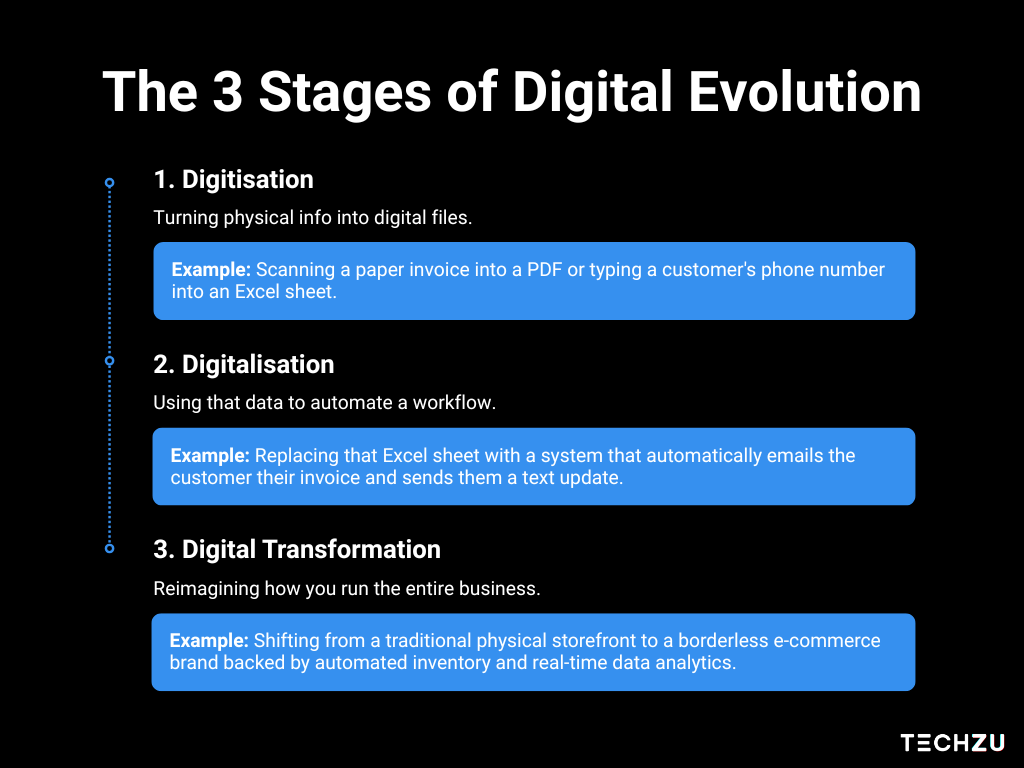
What Business Digitalization Looks Like for a Singapore SME
For a small business owner, digitalisation isn’t about complex coding or expensive software. It shows up as simple improvements, such as:
- In Sales, it can be moving from cash-only or manual bank transfers to giving customers a unified PayNow QR code or online credit card checkout.
- In Operations, it can be replacing a WhatsApp text to make an appointment with a digital calendar app where customers book their own slots 24/7.
- In Marketing, it can be moving from physical flyers to targeting local customers via social media tracking and automated email newsletters.
- In Finance, it can be swapping stacks of paper receipts for cloud accounting software like Xero that automatically tracks expenses and links directly to your corporate bank account.
Digitalisation changes how efficiently you deliver it to a world that lives on its phones.
What Happens To SMEs Who Don’t Digitalise?
Today’s customers expect instant replies, seamless websites, and the convenience of shopping everything digitally, from booking your services to making payments.
While you may be doing fine right now, your competitors could already be meeting those expectations better with faster websites, automated customer support, smoother checkout experiences, and even using real-time data to make smarter business decisions.
In Singapore specifically, delay carries an extra, very real opportunity cost: unclaimed grants. The government actively co-funds up to 50% to 70% of your technology costs through grants like the PSG, EDG, and CTC.
But grants aren’t the only thing you’re missing out on. Let’s look at the seven other ways delaying business digitalization is holding your business back right now.
1. You’ve become invisible to the customers who matter most
Singapore shoppers no longer see “online” and “offline” as separate worlds. They expect to move between a website, an app, and a physical shop seamlessly. In fact, more than 60% of all retail spending in Singapore now comes from people who buy this way, and businesses meeting this demand are growing their sales three times faster than traditional stores.
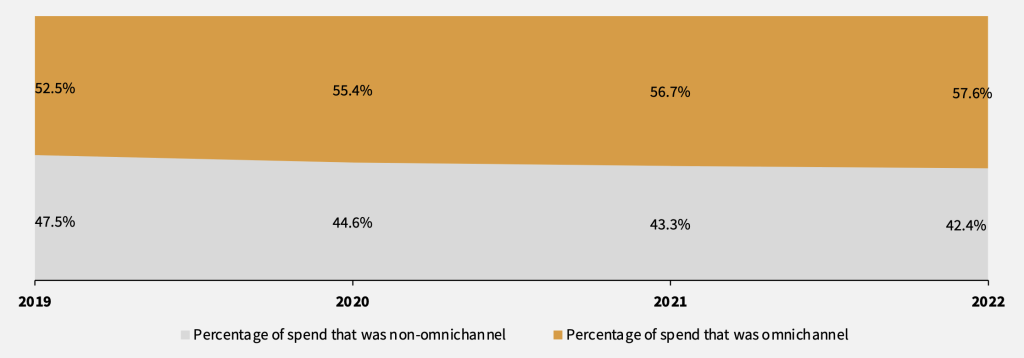
Source: Global Data
Think about how you shop yourself.
When you need something, you don’t just walk blindly into a store anymore. You browse their products on their website or mobile app while winding down at night. The next morning, you drop them a quick question on WhatsApp expecting an equally quick response. You pay instantly via PayNow, and you swing by their shop to collect it on your way home from work.
That is a single, unified experience, and it is exactly what your own customers expect from you. If your website is broken, your WhatsApp goes unanswered, or your channels don’t talk to each other, buyers won’t fight your system. They will simply click away and buy from a competitor who makes it easy.
| Techzu Insight: The most common frustrations for SME customers are the lack of online booking, digital payments, and live chat. |
2. You’re paying a hidden “inefficiency tax” every single day
Manual, paper-based, or disconnected spreadsheet processes don’t just feel slower, they cost real money in wasted hours, duplicated data entry, and errors that need fixing later.
According to IMDA’s Annual Report, SMEs that have adopted AI-enabled digital tools under Singapore’s PSG Grant reported cost savings of up to 50%, a shocking figure that suggests just how much slack exists in un-digitalised operations.
By 2026, SMEs aren’t just adopting tech, they’re deepening its use. Local adoption jumped from 2.0 to 2.3 digital areas in a single year as businesses aggressively automate to work faster and smarter.
So if you’re not automating repetitive tasks, digitising paperwork, or connecting your business systems, your competitors are pulling further ahead day by day.
| Techzu Insight: An aircon servicing company in Singapore saved over 20 hours a week just on appointment scheduling after implementing our Field Service Management System, and used those hours to secure 10% more sales in existing customers and contract renewal than before. |
3. You’re losing your greatest talents
Singapore is facing its tightest labour shortage in a decade, with a staggering 83% of employers struggling to find good talent. In a market this competitive, you cannot afford to handicap your own recruitment.
The truth is that top candidates, even for basic admin, sales, or operational roles, actively avoid companies stuck in the past. When a potential hire sees you relying on paper files, manual spreadsheets, and clunky workflows, it signals a business that is stagnating. According to Adobe’s State of Work report, 49% of employees said they will quit a job if the technology is outdated or hard to use.
So if your systems are frustrating to use, your best employees will leave for a competitor who makes their job easier.
4. You don’t actually own your company’s most valuable asset: your data
Ask yourself a simple question: if your top salesperson resigned tomorrow, who owns your customer relationships?
In traditional SMEs, customer details, deal histories, and ongoing conversations sit inside individual employees’ personal WhatsApp accounts, phone contacts, or private Excel sheets. If they walk out the door, your business data leaves with them. You are left starting from scratch, while your ex-employee moves your clients straight to a competitor.
Digitalisation fixes this vulnerability by consolidating customer interactions into a single, company-owned system like a CRM or ERP. When customer data lives in a unified platform:
- The company owns the relationships. Staff turnover, but client records, interaction histories, and sales pipelines remain securely with the business.
- You are ready for AI Agents. AI Agents, the next big productivity phase for Singapore SMEs, cannot operate on scattered WhatsApp chats. They require clean, centralised data to automate customer follow-ups, handle bookings, and drive sales.
With Singapore’s rising manpower costs, deploying AI Agents will soon be essential to scaling revenue without bloating headcount. But if your data isn’t structured and centralized in a system today, you won’t be able to leverage AI tomorrow.
5. The longer you wait, the more expensive catching up become
Singapore has spent years building one of the most generous SME digitalisation support systems in the world, and much of it is time-limited or capacity-limited. The flagship SMEs Go Digital programme has supported around 88,000 SMEs since its 2017 launch, and applications of PSG-supported solutions grew from an average of 800 firms in 2018 to 4,000 firms in 2020.
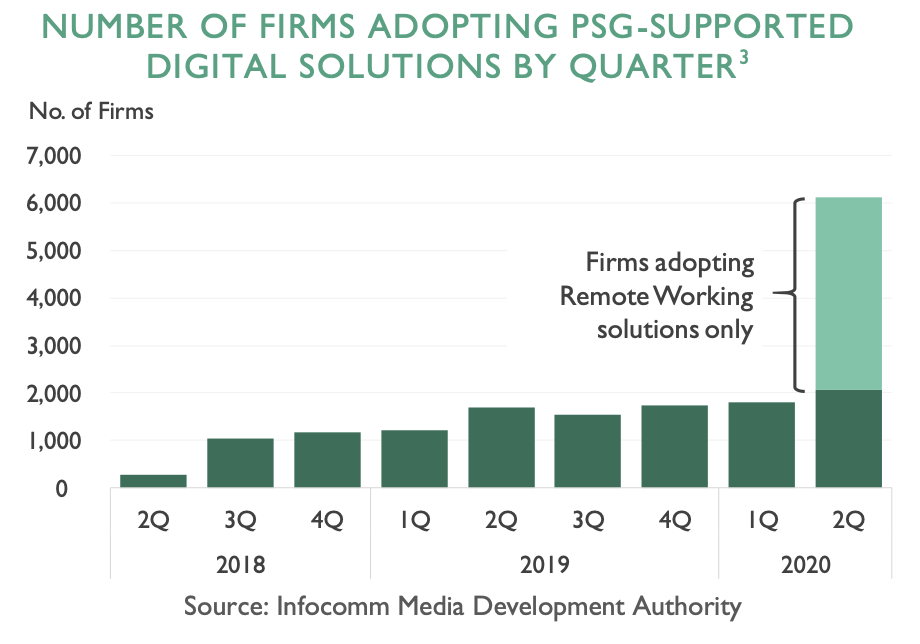
And there’s a simple reason so many moved quickly: the cost of waiting only goes up.
As with most things in Singapore, costs on software, implementation, and vendor fees only go up over time. A grant might cover 50% of your project cost today, but that same 50% covers less as prices rise. That’s exactly why you shouldn’t wait any longer. Every year you delay, you’re paying more for the same outcome.
6. You’re making decisions on gut feel when your competitors are making them on data
Without digital tools, most SME owners are essentially blind. Relying on memory, instinct, and whatever numbers happen to be visible on a bank statement or a stack of receipts.
Meanwhile, more mature businesses are combining live sales data, customer behaviour, and inventory tracking to answer questions that used to take weeks of guesswork:
- Which product to restock?
- Which marketing channel to double down on?
- Which customer segment is actually profitable?
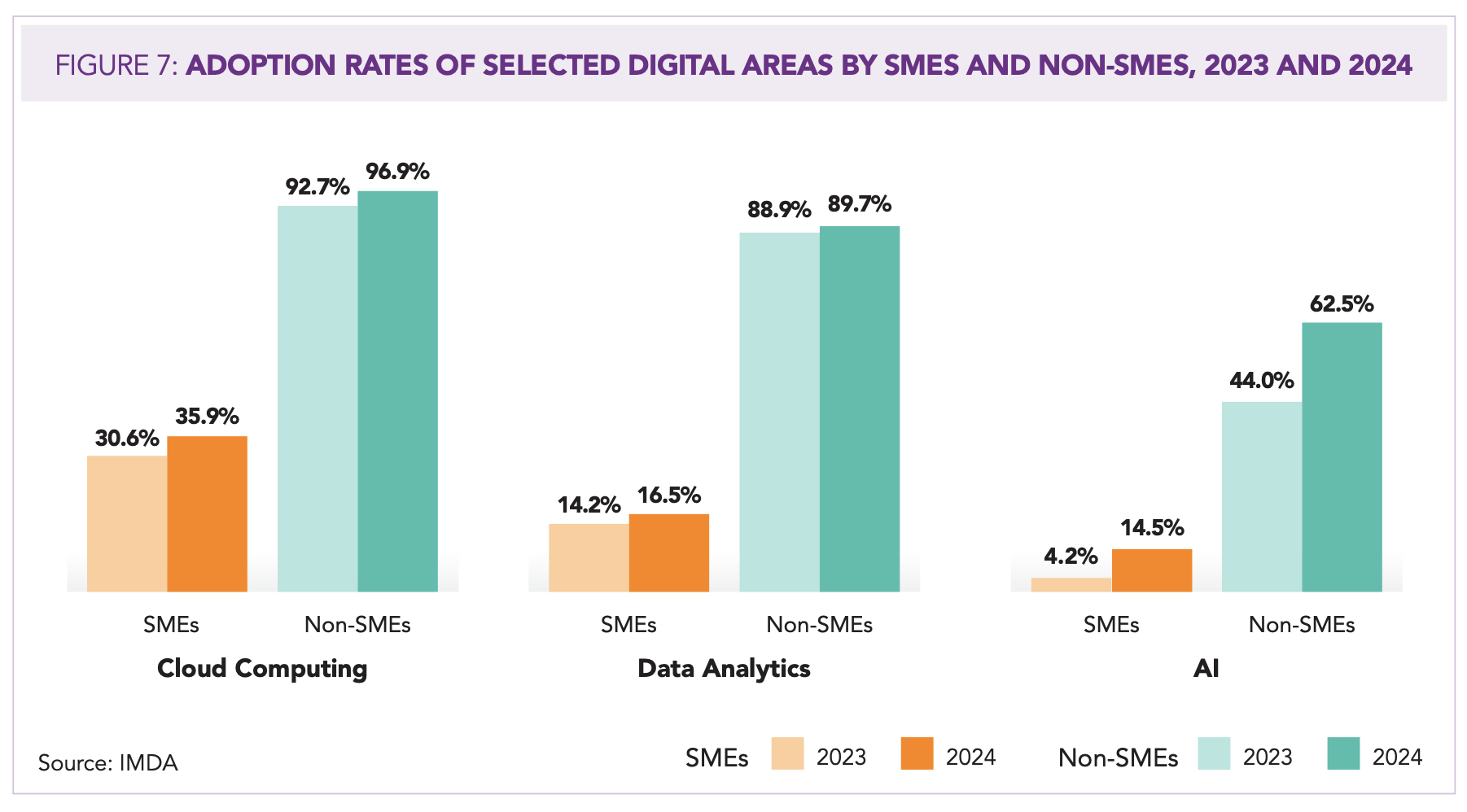
Singapore SMEs adopting AI tripled from just 4.2% to 14.5%, and firms using it are overwhelmingly applying it to practical, decision-support functions like finance, customer service, and operations.
| Techzu Insight: SMEs in F&B and E-Commerce that deal with inventory and pricing find the most use in having real-time data. |
7. Your competitors are using AI to outrun you with the same headcount
This is where waiting hurts the most. AI adoption among Singapore SMEs isn’t a future trend anymore, it’s already reshaping what “normal” productivity looks like.
SME AI adoption rates tripled between 2023 and 2024, and firms that have adopted it are already restructuring around it. According to the 2025 Singapore Digital Economy Report, 68% of AI-using firms plan to train workers in AI-related skills, and 63% intend to redesign jobs and workflows around AI-enabled processes. Even everyday staff usage is climbing fast: 73.8% of surveyed employees reported using AI tools in their work in 2025, many on a weekly or daily basis.
| Techzu Insight: Many SME owners have started to use AI agents to run daily operations on autopilot, allowing them to handle leads, bookings, and customer replies without relying heavily on the owner. |
Conclusion
Business digitalisation is no longer about staying ahead of the competition. It’s about keeping up.
Every day you delay means more customers lost, more hours wasted, more opportunities missed, and a bigger gap to close later. The best time to start was yesterday. The next best time is today.
If you’re looking for an expert team to digitalise your business, Techzu’s digital solutions are built for exactly this kind of work and will handle everything from grant support to AI automation and custom software tailored to your workflow.
About Techzu
Techzu is an award-winning digital partner helping Singapore SMEs automate, grow, and compete with cost-effective, ROI-driven solutions in AI, automation, website development, and custom software, backed by 120+ successful projects for 80+ clients across multiple industries.
FAQ
Pick one problem, not the whole business. Look back at the 7 areas above and identify which one is costing you the most right now, then find a single tool or vendor that solves it. Apply for PSG, EDG, or CTC funding before you sign anything or make any payment, since starting early disqualifies your application.
Customer communication and payments, in most cases. They’re usually the fastest to implement, the cheapest to fund under PSG, and the most visible to customers, so the win shows up quickly. Inventory or data tracking is a good second step once the first system is running smoothly.
Less than most owners assume once grants are factored in. PSG covers up to 50% of qualifying costs, capped at S$30,000 per company per financial year. For bigger transformation projects, like custom AI systems, EDG covers up to 50-70% of eligible costs with no funding cap, though these projects typically range from S$50,000 to over S$1 million.
For PSG-funded, off-the-shelf tools like accounting or CRM software, grant approval typically takes 4 to 6 weeks. For larger EDG-backed custom projects, typical processing time is 8-12 weeks from a complete application, with the build itself on top of that.
You can choose to handle the process yourself or engage a pre-approved digital vendor like Techzu to assist you.
1. Search the GoBusiness portal for pre-approved solutions yourself, or consult a digital partner to recommend the best package for your business.
2. Request a vendor quotation directly on the portal, or let your engaged agency draft a tailored proposal with all necessary grant documentation.
3. Log into the Business Grants Portal with CorpPass to submit the application yourself, or have your agency guide you through the process.
4. Wait for official approval before signing contracts or making payments, as retrospective applications are disqualified.
Most SMEs choose to work with a pre-approved digital partner to accurately scope their project and maximise their eligible funding support.
Start by adopting an Integrated Point of Sale (POS) system that links real-time inventory tracking with digital payment methods (such as PayNow and credit cards). Connect this to an omnichannel platform like Shopify or WooCommerce to keep your online and physical stock automatically synchronized.
– Payments: PayNow Corporate, GrabPay, Stripe.
– Accounting: Xero (PSG pre-approved and linked with major Singapore banks).
– E-Invoicing: InvoiceNow-compliant solutions (PEPPOL network).
– HR & Payroll: Info-Tech, JustLogin, Talenox.
1. Identify key bottlenecks: Audit manual tasks (e.g., invoicing, booking) to pick 1-2 priority areas.
2. Choose SaaS platforms: Opt for plug-and-play cloud platforms that charge monthly subscriptions instead of high upfront capital costs.
3. Train staff in phases: Roll out new software gradually alongside old processes to minimize operational disruption.
An entry-level cloud ERP system (1-2 modules) typically costs $10,000-$30,000, while mid-sized implementations range from $30,000 to $150,000+ before grants. With government subsidies like the PSG, CTC, or EDG, eligible SMEs can offset up to 50% of qualifying costs.
AI speeds up response times by handling routine FAQs 24/7 through smart chatbots and AI agents. It can automatically collect initial customer details, check order statuses, process payments, and route complex cases to human support staff without increasing headcount.
Look for accredited solution providers listed under IMDA’s Digital Leaders Programme or SMEs Go Digital. You can also work with local agency partners that offer end-to-end service, from technology integration to grant application assistance.
– Role-Based Access Control (RBAC) which grants employees access strictly to the data necessary for their roles.
– Regular encrypted backups to maintain offline or cloud backups following the 3-2-1 rule (3 copies, 2 media types, 1 offsite).
– Ensure PDPA compliance by implementing transparent consent policies for customer data under Singapore’s Personal Data Protection Act.